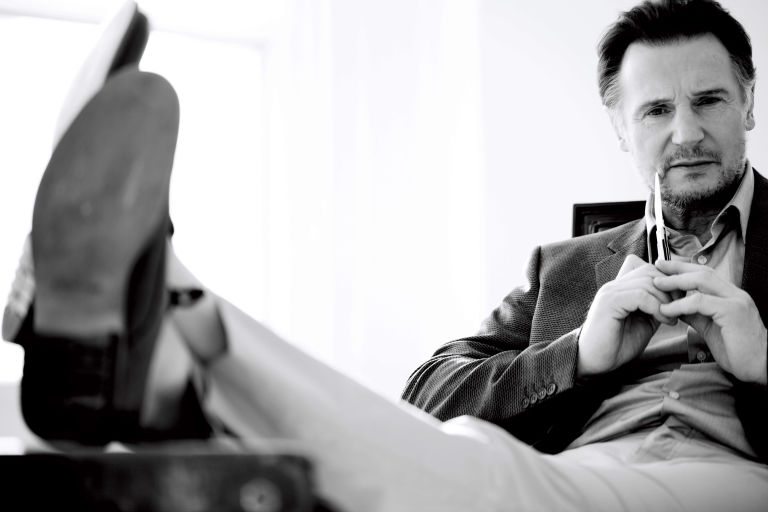
Liam Neeson, in full
William Neeson
(born
June 7, 1952,
Ballymena,
Northern Ireland), Irish American actor perhaps best known for playing powerful leading men.
Neeson was an accomplished boxer in his early years. He abandoned that activity, however, and entered Queen’s University
Belfast with the intention of studying
physics and
computer science.
After a year he left college and worked as a forklift driver for a
time, but he then began studying to become a teacher. He also took drama
classes, and in 1976 he joined Belfast’s Lyric Players Theatre.
Two
years later Neeson joined the prestigious
Abbey Theatre in
Dublin, and in 1979 he made his
motion picture debut in
Christiana, a religious educational film. He followed that with the role of Sir
Gawain in
Excalibur (1981), which led to supporting roles in such films as
The Bounty (1984),
The Mission (1986), and
Suspect (1987). Among his
television appearances were the miniseries
Ellis Island and such series as
Miami Vice, both in 1984.
![Kingsley, Sir Ben: still with Neeson and Kingsley from “Schindler’s List” [Credit: ™ and © 1993 Universal City Studios and Amblin Entertainment, Inc., all rights reserved.]](https://lh3.googleusercontent.com/blogger_img_proxy/AEn0k_vj0sPnzageARi6IWB-ZONRhbfb72rcJeQNeWJRwa2O7DaHksnBd_qOFOeiuja4to-fF6K8MRD50iSRkTEoibMLbob4oz_o2kEd4Igvx0CTXIZ9k_NiW_ek3Dld9B8a6wVuoSBrSYsR=s0-d)
Neeson’s first motion picture lead came in
Darkman (1990), but the film failed to garner much notice. In 1992 he made his
Broadway debut in a revival of
Eugene O’Neill’s
Anna Christie, costarring with
Natasha Richardson. (The couple married in 1994; Richardson died in 2009 after sustaining a head injury in a
skiing accident.) The production caught the attention of director
Steven Spielberg, who cast Neeson as the
Holocaust hero
Oskar Schindler in
Schindler’s List (1993). The role earned Neeson an
Academy Award nomination for best actor.
After starring opposite
Jodie Foster in
Nell (1994), Neeson portrayed the
legendary Scottish clan leader in
Rob Roy (1995) and the
Irish revolutionary in
Michael Collins (1996). In 1998 he appeared as
Jean Valjean in a film adaptation of
Victor Hugo’s
Les Misérables. That year he also returned to the stage to portray
Oscar Wilde in
The Judas Kiss in
London and on Broadway. In 1999 Neeson starred as a Jedi master in
Star Wars: Episode 1—The Phantom Menace, the first installment in the
popular series’ prequel
trilogy.
Barbara Whitney
In
the early 21st century Neeson was cast in a series of films that
continued to underscore his versatility. In 2002 he portrayed an
immigrant gang leader in
Martin Scorsese’s historical epic
Gangs of New York. After appearing as a widower in the comedy
Love Actually (2003), he portrayed zoologist and student of sexual behaviour
Alfred Kinsey in
Kinsey (2004). Neeson went on to have supporting roles, albeit important ones, in the movies
Kingdom of Heaven and
Batman Begins (both 2005). Additionally, he voiced the digitally animated lion Aslan in
The Chronicles of Narnia series (2005 and 2008). After starring opposite
Pierce Brosnan in
Seraphim Falls (2006), a 19th-century tale of revenge, Neeson played an ex-
CIA agent trying to recover his kidnapped daughter in
Taken (2008); its box-office success led to sequels in 2012 and 2014.
![Neeson, Liam [Credit: Adam Kuehl—Savannah College of Art and Design/PRNewsFoto/AP Images]](https://lh3.googleusercontent.com/blogger_img_proxy/AEn0k_uK6YltpGD-pl-4urOAlG1ILIAdZZOkjGd3oMOB7E3-fydTt7JIrGFDBKqzzXUjFNn-MQcbq3qBxIZeeJE3D49U5wFk0k9UPKlID5svEcqRP02rjzz7R1BeAnnw29gL-R60wm_1BwVedw=s0-d)
In 2009 Neeson provided the voice of a sorcerer in
Ponyo, the English version of
Miyazaki Hayao’s
Gake no ue no Ponyo (2008; “Ponyo on the Cliff”). His subsequent films include
Chloe (2009), in which he played a husband whose wife hires a prostitute to test his fidelity, and the action-adventure
Clash of the Titans (2010), in which he played
Zeus. (He reprised the role in the sequel
Wrath of the Titans [2012].) In 2010 Neeson also starred in
The A-Team, an action drama based on the 1980s television series, and appeared as an escaped convict in the thriller
The Next Three Days. He later appeared in the thrillers
Unknown (2011), as a man seeking to reclaim his stolen identity, and
The Grey (2012), as a plane-crash survivor contending with the Alaskan wilderness. He was featured in the drama
Third Person (2013) as a novelist engaged in an extramarital affair. Neeson portrayed an air marshal in the action movie
Non-Stop (2014), an outlaw in the comedy
A Million Ways to Die in the West (2014), a private investigator in the crime thriller
A Walk Among the Tombstones (2014), and a hit man in the propulsive
entertainment Run All Night (2015). He voiced characters in the
computer-animated romps
The Nut Job (2014) and
The LEGO Movie (2014).
Among Neeson’s later theatrical roles was John Proctor in a 2002 production of
Arthur Miller’s
The Crucible on Broadway.
January
is the dumping month for movies. Any film with award aspirations has
been released during November and December to qualify for Oscar
nominations, while tentpole pics hit screens during the
blockbuster-making holiday season. Those first few weeks of the year are
when movies that have gotten lousy scores in test screenings or have
been gathering dust on studio shelves get their day, with the
expectation that they’ll hang around theaters no longer than the popcorn
sticking to the floor.
The box office takes the deepest dive on Super Bowl
weekend, so it was a Hail Mary pass when on Friday, Jan. 30, 2009—two
days before nearly 100 million Americans would watch the Pittsburgh
Steelers defeat the Arizona Cardinals—20th Century Fox released
Taken.
The action flick had a paltry budget of $25 million and a familiar
revenge plot—former CIA agent Bryan Mills sets out to rescue his
daughter when she’s kidnapped in Paris by a gang of sex traffickers.
“That release date took guts,” says Paul Dergarabedian, a box-office
analyst for Rentrak, a provider of viewership data. “It went against the
grain. What you typically see opening on Super Bowl weekend are
romantic comedies that are aimed at a female audience.” Even the movie’s
star, a then 56-year-old Liam Neeson, had thought that the movie—what
he describes as a “very, very basic, simple storyline”—would stay under
the radar.
It didn’t. Opening on some 3,200 screens, Taken
nabbed the No. 1 spot at the box office, earning a remarkable
$24.7 million. Even Fox Chairman and CEO Jim Gianopulos was astonished.
“We’d screened the film and went, Wow, this is really great,”
Gianopulos says. “The release calendar gets very crowded during the
holiday season, and while we knew what we had, we also knew we needed
word-of-mouth for the movie to get momentum. So we weren’t surprised
that the movie turned out to be a success, but we were very surprised by
the extent of it that first weekend.”
Taken would go on to earn $145 million in
domestic box office receipts and nearly $84 million internationally,
making Liam Neeson an action star and giving rise to a franchise. Three
years later in
Taken 2,
protagonist Bryan Mills and his estranged wife (Famke Janssen) are
kidnapped in Istanbul. That film would earn $376 million worldwide. And
on Jan. 9, the final
Taken installment opens; this time Mills
is on the run after being framed for the murder of his ex. Neeson, 62,
is one of Hollywood’s highest-paid stars, on track to earn a reported
$50 million for
Taken 3. “I laugh at it,” he says. “It’s not
that I laugh at the franchise itself or the position I find myself in. I
just laugh at the ridiculousness of life.”
At 6 feet 4 inches, with the slightly off-kilter
features of the amateur boxer he once was (he broke his nose in a match
at 15), Neeson always had the rough-hewn good looks of an action hero.
If it’s improbable that it took until late middle age for him to achieve
that mantle, Neeson says that timing is just right. Had Taken
come along in his 20s or 30s, he says he would have screwed it up (he
uses a saltier word), and typecasting might have made it difficult for
him to be believable playing the towering historical figures that have
defined him as one of the greatest actors of his generation.
“I certainly wouldn’t have been able to do
Schindler's List or
Rob Roy or
Michael Collins,”
he says. Besides, he adds, “I think that what added to the popularity
of Taken was the fact that I’m an elder guy. I’m a father, so I can
totally empathize with how Bryan Mills reacts when his kid is in danger.
I think that comes across.” What’s left unsaid is that audiences also
know Neeson has dealt with a devastating loss—the death of his wife,
actress Natasha Richardson, after a 2009 skiing accident. “He’s lived
through a lot,” says Olivier Megaton, who directed
Taken 2 and
Taken 3. “You feel his humanity and his struggle. He knows life can be very hard, bad things happen, and you just keep on fighting.”
In real life, Neeson has some traits you’d never
associate with an action hero. He’s afraid of heights, for one thing.
For another, he had to give up boxing because he blacked out during
bouts. And his idea of a good workout is a 90-minute walk through
Central Park or near his home in upstate New York, a habit he took up as
part of his rehab when he had a near-fatal motorcycle accident in 2000.
(But make no mistake, these are power walks. “I’ve done some of those
walks with Liam,” says actor Aidan Quinn, a good friend and godfather to
Neeson’s younger son, Daniel. “And the man moves; his stride is fast.
These are deep-in-your-adductors, heart-pounding walks.”) And Neeson is a
voracious reader who’s always juggling a few books. He’s reading The Richard Burton Diaries and a crime novel by the British writer John Burdett, plus a thriller by Scandinavian author Kristina Ohlsson.
Introverted and bookish, Neeson might be a very
different person from Bryan Mills, but, says Janssen, “If you were in
danger, Liam is the person you’d want to have rescuing you.” Actress
Laura Linney agrees. She and Neeson are close friends—she starred
opposite him in the films
Kinsey,
The Other Man and
Love Actually, and on Broadway in
The Crucible.
“I always feel safe when I’m around Liam,” Linney says. “Some of that
is his strength and masculinity and his great looks. But beyond those
superficial reasons are deeper ones, like his devotion as a friend. It’s
not the big heroic gestures; it’s the little ones. Liam keeps in touch;
he’s aware of what you’re going through. You feel appreciated by him.”
When Linney wed, just four months after Richardson’s death, Neeson
walked her down the aisle.
Women in large numbers are smitten with Neeson. A big part of the success of the Taken
movies, says Gianopulos, is that they draw a far more sizable female
audience than is typical of action pictures. But to paraphrase a
sentiment first applied to James Bond, if women want to be around
Neeson, men want to be him. “There are some leading men who piss other
men off and make them angry, jealous and uncomfortable,” Linney says.
“Liam isn’t one of them, and I think that’s because he has an innate
modesty and an innate decency that’s comforting. Everyone—men and
women—feel better when he’s around.” That’s certainly true for Megaton.
“The first time I met Liam,” he recalls, “he said, ‘If you need me, I’m
here to protect you.’ When you make a movie, you have a million problems
a day, and Liam wanted to be there for me.”
In fact, men’s admiration for Neeson can undermine his
ability to play a convincing tough guy in real life. Maggie Grace, who
portrays Neeson’s daughter in the Taken trilogy, was 24 when
she made the first film and, she says, “trying to get over a boy who
broke my heart.” Neeson, with a combination of humor and paternal
concern, called the guy, leaving a version of the speech he made famous
in Taken: “I have a very particular set of skills, skills I
have acquired over a very long career. Skills that make me a nightmare
for people like you…. I will look for you, I will find you, and I will
kill you.”
“We tailored the speech to scare the living beejesus out
of the guy,” Grace says. “But it backfired when he figured out it was
really Liam and not an amazing Liam impersonator. He was so excited.
‘Liam Neeson called my office! That’s the coolest thing ever! Do you
have a video of it?’ Liam and I laughed so hard.” Still, even if that
prank call failed to intimidate, “What girl,” says Grace, “doesn’t want a
father figure like Liam freakin’ Neeson to watch out for her now and then?”
Neeson has made some 70 movies, 15 in the last three
years alone. In April he stars as an aging hit man in Run All Night, has
a small part in the comedy Ted 2, and then the title role in A Monster Calls, an adaptation of the children’s fantasy novel. Clearly, even if that reported $50 million Taken 3
windfall is off by a few mil, he’s not doing back-to-back flicks for
the paycheck. Instead Neeson works nearly nonstop because, he says, “I
absolutely adore the business” and because people ask him to. “I get a
kick out of complete strangers getting in touch with my agent or sending
me a script that they want me to be in,” he says. “There’s a part of me
that’s like the little boy in a toy shop thinking, Oh, I want to have that, I want to have that, and I want that. Can I do both those jobs? Can I do all three? And you know, I also want to please everybody and do it all.”
That work ethic was forged in Neeson’s modest upbringing
in the Northern Ireland town of Ballymena. “I’m not going to give you
some sob story about how we were at death’s door because of poverty,” he
says, “but we were very, very working class. My mother worked as an
assistant cook. My father had, let’s say, long periods of unemployment
and eventually became a grammar school custodian. So money was tight.”
Neeson began working on construction sites when he was 15. “You got paid
on a Thursday, and you came in and handed your wages to your mom,” he
says. “It was a great feeling of achievement. It does make you feel
grown up. It does
make you feel responsible.
You realize your place in the world when you have a job, and when you
get paid in that little brown envelope, it connects you to the rest of
working humanity, and that just felt very, very comforting.”
He learned another lesson about humanity from his
grandfather, a steam-engine driver. Once he retired, he’d scan the
newspaper every morning to see who had died. “Inevitably he’d find some
name, say O’Rafferty, and he’d think, I wonder if that was the guy I
worked with 30 years ago,” Neeson says. “He’d find out where this
gentleman was being buried, and he’d walk there. He was a fantastic
walker. When I was 6 or 7 or 8, he’d sometimes make me go with him, and
we’d walk for what seemed like miles. I remember standing around those
graves, just the priest, an altar boy, my grandfather and me while some
prayers were said. That became my grandfather’s later-life vocation. He
believed
every life means something. Like Biff Loman’s mother says to her son in Arthur Miller’s
Death of a Salesman, ‘Attention must be paid to such a man. Attention must be paid.’ ”
Neeson began acting when he was 11, attracted to the
stage because a girl he liked who had “skin of alabaster and cherry-red
lips” was starring in the school play. He kept acting in school
productions and later attended Queen’s University in Belfast. Interested
in becoming a teacher, he took classes elsewhere, but those studies
didn’t hold his interest, and he dropped out to pursue acting. He joined
the Lyric Players’ Theatre in Belfast and two years later began
performing with Dublin’s famed Abbey Theatre. At 28 he got his first
high-profile movie role, Sir Gawain in
Excalibur.
The 1981 film starred Helen Mirren, and the two began a romance that
lasted four years. “I fell in love with Helen Mirren,” Neeson recalled
on
60 Minutes. “Oh my God. Can you imagine riding horses in
shiny suits of armor, having sword fights and stuff, and you’re falling
in love with Helen Mirren? It doesn’t get any better than that.”
After that action fantasy, Neeson had supporting roles in movies such as
The Mission, an 18th-century adventure starring Robert De Niro, and played opposite Cher in
Suspect and Diane Keaton in
The Good Mother.
Fans of Sonny Crockett and Rico Tubbs might recall Neeson’s portrayal
of a former member of the Irish Republican Army in a 1986
Miami Vice episode.
His first starring role was the 1990 fantasy thriller
Darkman, and in 1993 he was cast as Oskar Schindler in the masterful Steven Spielberg Holocaust drama
Schindler’s List,
which led to an Academy Award nomination. But his performance left him
dissatisfied. (“I thought the film was quite extraordinary except for
myself,” he has said. “I didn’t own the part. I didn’t see enough of me
in there.”) He would go on to win critical raves playing an 18th-century
Scottish Highlander in
Rob Roy, the Irish revolutionary Michael Collins and sex researcher Alfred Kinsey in
Kinsey.
There were lots of other high-profile roles: in Martin Scorsese’s
Gangs Of New York and Woody Allen’s
Husbands And Wives, in
Star Wars: Episode I - The Phantom Menace and
Batman Begins. Straddling genres, he did Westerns (
Seraphim Falls) and comedies (
A Million Ways to Die in the West and
Gun Shy), battled the bad guys on a submarine (
K-19: The Widowmaker) and a plane (
Non-Stop), and fought off wolves (
The Grey) and deviant drug lords (
A Walk Among the Tombstones). Leaving his snarling demeanor aside, he voiced Aslan the lion in the
Narnia movies, and the good cop and bad cop in
The Lego Movie.
Neeson says when he catches some of his old movies as he’s flipping through TV channels, he winces. In
Excalibur,
for example, “I’m chewing up the scenery,” he says, then adds, “God
knows I’ve done some not-very-good movies. But it’s always a learning
curve, always. I always try and
come away from the experience having learned something or some things.”
His more recent acting is less likely to make him cringe. “Overall I
think I’m a much better actor now that I’m older,” he says. “I feel very
comfortable in front of a lens and nothing throws me off. Be I in a
suit of armor with a false beard, on horseback being chased by dragons
or looking at a Russian terrorist: It’s OK; this is the story. This is
what I have to do. And I like to think I’ve minimalized my acting over
the years, meaning I’ve achieved something whereby less is more.”
Megaton says Neeson is very precise in his acting. “He
likes to go very far into the realities of his character,” the director
says. “We had an ex-CIA agent consulting on Taken 3, and Liam would ask lots of questions, like how he’d walk into a room when he knew that inside there were people with weapons.”
There’s a favorite Samuel Beckett quote that Neeson and
his late wife shared: “Ever tried. Ever failed. No matter. Try again.
Fail again. Fail better.” Neeson and Richardson met in 1992 after being
cast in the Eugene O’Neill play Anna Christie on Broadway. “She and I were like Astaire and Rogers,” Neeson told 60 Minutes.
“We had just this wonderful kind of dance, free dance on stage every
night, you know?” They wed in July 1994 at the couple’s farmhouse in
upstate New York; their son Micheál was born in 1995 and Daniel the
following year.
“They were a fantastic couple,” Quinn says. “Natasha was
always organizing some great gathering at their place. The parties they
used to have once or twice a year were legendary. Natasha would take
care of every detail. She was a great chef; there would always be great
wine and spirits, good music. She loved bringing people together.
Natasha had her shy side, but she was much more of an extrovert than
Liam, and when it came to socializing, she was the motor.”
Whenever Neeson or Richardson did theater, they kept the
Beckett quote in their dressing room as inspiration. “You’ve come
offstage,” Neeson says, “you’ve done a lousy performance for whatever
reason, and you get a chance to go on stage the next night and the night
after that for four or five months. You make it better, but you have to
be there. You have to come back to the plate again. You have to keep
always coming to the plate.”
For Neeson the quote resonated beyond acting. “You think
all things are lost, but it’s not lost,” he says. “There’s always
hope.” It was a belief he needed to draw upon in March 2009. Neeson was
in Toronto filming the movie
Chloe
when Richardson called from a Quebec ski resort where she was on
vacation with Micheál. She’d fallen and hit her head coming down a
beginner slope. “Oh, darling,” she said to Neeson, “I’ve taken a tumble
in the snow.”
In fact, although she didn’t know it, Richardson had
suffered a traumatic brain injury. By the time Neeson reached the
hospital in Montreal, X-rays showed she was brain-dead.
The couple had a pact: If either of them was ever in a
vegetative state, the other would pull the plug. Neeson gave the
directive. Richardson’s heart, kidneys and liver were donated, “so,
she’s keeping three people alive,” Neeson says. “And I think she would
be very thrilled and pleased by that.”
Days after Richardson’s funeral, he was back on the set of
Chloe. He wanted, he says, to be a good example to his sons, then ages 13 and 12. “You just say to yourself,
You can’t fall apart,”
Neeson says. “And you just can’t. You’re responsible for two lives. Of
course, it’s a tragedy, and life throws awful curveballs at you
sometimes, but
you have to cope.”
He gained strength, he says, from his family and from Richardson’s,
including her mother, actress Vanessa Redgrave, with whom he’s very
close. “You could ask them to do anything, and it would be done,” he
says. “They stopped their lives to look after us. I was very, very
lucky.”
The epitaph on Richardson’s tombstone is “Cast your
bread upon the water, and it will be returned tenfold.” Neeson is, by
the account of his friends, extraordinarily generous. Aidan Quinn says
he has made large contributions to the school that Quinn’s daughter, who
is autistic, attended. When Maggie Grace made her Broadway debut in Picnic
in 2013, Neeson was there. It was the same theater where Neeson and
Richardson had performed. If it was painful for him, he didn’t show it.
“He came backstage, and everyone was so excited to see him,” Grace says.
“He still remembered funny stories and the names of the folks who had
been there when he and Natasha were in Anna Christie.”
Jules Daly, who was the producer on two of Neeson’s films—
The Grey and
The A-Team—sums
up his appeal. “Liam’s like the last man on earth,” she says. “He’s
chivalrous, but he’s a great supporter of women. He’s got your back.
This is a man who looks you in the eye when he asks you how you are. He
really, truly cares. He remembers things about your family, he wants to
see pictures of your kids, and he remembers the names of everyone on the
crew, down to the grips. Liam defines authentic.”
- See more at: http://www.success.com/article/liam-neeson-the-unlikely-action-hero#sthash.8Srkn4Ju.dpuf
January
is the dumping month for movies. Any film with award aspirations has
been released during November and December to qualify for Oscar
nominations, while tentpole pics hit screens during the
blockbuster-making holiday season. Those first few weeks of the year are
when movies that have gotten lousy scores in test screenings or have
been gathering dust on studio shelves get their day, with the
expectation that they’ll hang around theaters no longer than the popcorn
sticking to the floor.
The box office takes the deepest dive on Super Bowl
weekend, so it was a Hail Mary pass when on Friday, Jan. 30, 2009—two
days before nearly 100 million Americans would watch the Pittsburgh
Steelers defeat the Arizona Cardinals—20th Century Fox released
Taken.
The action flick had a paltry budget of $25 million and a familiar
revenge plot—former CIA agent Bryan Mills sets out to rescue his
daughter when she’s kidnapped in Paris by a gang of sex traffickers.
“That release date took guts,” says Paul Dergarabedian, a box-office
analyst for Rentrak, a provider of viewership data. “It went against the
grain. What you typically see opening on Super Bowl weekend are
romantic comedies that are aimed at a female audience.” Even the movie’s
star, a then 56-year-old Liam Neeson, had thought that the movie—what
he describes as a “very, very basic, simple storyline”—would stay under
the radar.
It didn’t. Opening on some 3,200 screens, Taken
nabbed the No. 1 spot at the box office, earning a remarkable
$24.7 million. Even Fox Chairman and CEO Jim Gianopulos was astonished.
“We’d screened the film and went, Wow, this is really great,”
Gianopulos says. “The release calendar gets very crowded during the
holiday season, and while we knew what we had, we also knew we needed
word-of-mouth for the movie to get momentum. So we weren’t surprised
that the movie turned out to be a success, but we were very surprised by
the extent of it that first weekend.”
Taken would go on to earn $145 million in
domestic box office receipts and nearly $84 million internationally,
making Liam Neeson an action star and giving rise to a franchise. Three
years later in
Taken 2,
protagonist Bryan Mills and his estranged wife (Famke Janssen) are
kidnapped in Istanbul. That film would earn $376 million worldwide. And
on Jan. 9, the final
Taken installment opens; this time Mills
is on the run after being framed for the murder of his ex. Neeson, 62,
is one of Hollywood’s highest-paid stars, on track to earn a reported
$50 million for
Taken 3. “I laugh at it,” he says. “It’s not
that I laugh at the franchise itself or the position I find myself in. I
just laugh at the ridiculousness of life.”
At 6 feet 4 inches, with the slightly off-kilter
features of the amateur boxer he once was (he broke his nose in a match
at 15), Neeson always had the rough-hewn good looks of an action hero.
If it’s improbable that it took until late middle age for him to achieve
that mantle, Neeson says that timing is just right. Had Taken
come along in his 20s or 30s, he says he would have screwed it up (he
uses a saltier word), and typecasting might have made it difficult for
him to be believable playing the towering historical figures that have
defined him as one of the greatest actors of his generation.
“I certainly wouldn’t have been able to do
Schindler's List or
Rob Roy or
Michael Collins,”
he says. Besides, he adds, “I think that what added to the popularity
of Taken was the fact that I’m an elder guy. I’m a father, so I can
totally empathize with how Bryan Mills reacts when his kid is in danger.
I think that comes across.” What’s left unsaid is that audiences also
know Neeson has dealt with a devastating loss—the death of his wife,
actress Natasha Richardson, after a 2009 skiing accident. “He’s lived
through a lot,” says Olivier Megaton, who directed
Taken 2 and
Taken 3. “You feel his humanity and his struggle. He knows life can be very hard, bad things happen, and you just keep on fighting.”
In real life, Neeson has some traits you’d never
associate with an action hero. He’s afraid of heights, for one thing.
For another, he had to give up boxing because he blacked out during
bouts. And his idea of a good workout is a 90-minute walk through
Central Park or near his home in upstate New York, a habit he took up as
part of his rehab when he had a near-fatal motorcycle accident in 2000.
(But make no mistake, these are power walks. “I’ve done some of those
walks with Liam,” says actor Aidan Quinn, a good friend and godfather to
Neeson’s younger son, Daniel. “And the man moves; his stride is fast.
These are deep-in-your-adductors, heart-pounding walks.”) And Neeson is a
voracious reader who’s always juggling a few books. He’s reading The Richard Burton Diaries and a crime novel by the British writer John Burdett, plus a thriller by Scandinavian author Kristina Ohlsson.
Introverted and bookish, Neeson might be a very
different person from Bryan Mills, but, says Janssen, “If you were in
danger, Liam is the person you’d want to have rescuing you.” Actress
Laura Linney agrees. She and Neeson are close friends—she starred
opposite him in the films
Kinsey,
The Other Man and
Love Actually, and on Broadway in
The Crucible.
“I always feel safe when I’m around Liam,” Linney says. “Some of that
is his strength and masculinity and his great looks. But beyond those
superficial reasons are deeper ones, like his devotion as a friend. It’s
not the big heroic gestures; it’s the little ones. Liam keeps in touch;
he’s aware of what you’re going through. You feel appreciated by him.”
When Linney wed, just four months after Richardson’s death, Neeson
walked her down the aisle.
Women in large numbers are smitten with Neeson. A big part of the success of the Taken
movies, says Gianopulos, is that they draw a far more sizable female
audience than is typical of action pictures. But to paraphrase a
sentiment first applied to James Bond, if women want to be around
Neeson, men want to be him. “There are some leading men who piss other
men off and make them angry, jealous and uncomfortable,” Linney says.
“Liam isn’t one of them, and I think that’s because he has an innate
modesty and an innate decency that’s comforting. Everyone—men and
women—feel better when he’s around.” That’s certainly true for Megaton.
“The first time I met Liam,” he recalls, “he said, ‘If you need me, I’m
here to protect you.’ When you make a movie, you have a million problems
a day, and Liam wanted to be there for me.”
In fact, men’s admiration for Neeson can undermine his
ability to play a convincing tough guy in real life. Maggie Grace, who
portrays Neeson’s daughter in the Taken trilogy, was 24 when
she made the first film and, she says, “trying to get over a boy who
broke my heart.” Neeson, with a combination of humor and paternal
concern, called the guy, leaving a version of the speech he made famous
in Taken: “I have a very particular set of skills, skills I
have acquired over a very long career. Skills that make me a nightmare
for people like you…. I will look for you, I will find you, and I will
kill you.”
“We tailored the speech to scare the living beejesus out
of the guy,” Grace says. “But it backfired when he figured out it was
really Liam and not an amazing Liam impersonator. He was so excited.
‘Liam Neeson called my office! That’s the coolest thing ever! Do you
have a video of it?’ Liam and I laughed so hard.” Still, even if that
prank call failed to intimidate, “What girl,” says Grace, “doesn’t want a
father figure like Liam freakin’ Neeson to watch out for her now and then?”
Neeson has made some 70 movies, 15 in the last three
years alone. In April he stars as an aging hit man in Run All Night, has
a small part in the comedy Ted 2, and then the title role in A Monster Calls, an adaptation of the children’s fantasy novel. Clearly, even if that reported $50 million Taken 3
windfall is off by a few mil, he’s not doing back-to-back flicks for
the paycheck. Instead Neeson works nearly nonstop because, he says, “I
absolutely adore the business” and because people ask him to. “I get a
kick out of complete strangers getting in touch with my agent or sending
me a script that they want me to be in,” he says. “There’s a part of me
that’s like the little boy in a toy shop thinking, Oh, I want to have that, I want to have that, and I want that. Can I do both those jobs? Can I do all three? And you know, I also want to please everybody and do it all.”
That work ethic was forged in Neeson’s modest upbringing
in the Northern Ireland town of Ballymena. “I’m not going to give you
some sob story about how we were at death’s door because of poverty,” he
says, “but we were very, very working class. My mother worked as an
assistant cook. My father had, let’s say, long periods of unemployment
and eventually became a grammar school custodian. So money was tight.”
Neeson began working on construction sites when he was 15. “You got paid
on a Thursday, and you came in and handed your wages to your mom,” he
says. “It was a great feeling of achievement. It does make you feel
grown up. It does
make you feel responsible.
You realize your place in the world when you have a job, and when you
get paid in that little brown envelope, it connects you to the rest of
working humanity, and that just felt very, very comforting.”
He learned another lesson about humanity from his
grandfather, a steam-engine driver. Once he retired, he’d scan the
newspaper every morning to see who had died. “Inevitably he’d find some
name, say O’Rafferty, and he’d think, I wonder if that was the guy I
worked with 30 years ago,” Neeson says. “He’d find out where this
gentleman was being buried, and he’d walk there. He was a fantastic
walker. When I was 6 or 7 or 8, he’d sometimes make me go with him, and
we’d walk for what seemed like miles. I remember standing around those
graves, just the priest, an altar boy, my grandfather and me while some
prayers were said. That became my grandfather’s later-life vocation. He
believed
every life means something. Like Biff Loman’s mother says to her son in Arthur Miller’s
Death of a Salesman, ‘Attention must be paid to such a man. Attention must be paid.’ ”
Neeson began acting when he was 11, attracted to the
stage because a girl he liked who had “skin of alabaster and cherry-red
lips” was starring in the school play. He kept acting in school
productions and later attended Queen’s University in Belfast. Interested
in becoming a teacher, he took classes elsewhere, but those studies
didn’t hold his interest, and he dropped out to pursue acting. He joined
the Lyric Players’ Theatre in Belfast and two years later began
performing with Dublin’s famed Abbey Theatre. At 28 he got his first
high-profile movie role, Sir Gawain in
Excalibur.
The 1981 film starred Helen Mirren, and the two began a romance that
lasted four years. “I fell in love with Helen Mirren,” Neeson recalled
on
60 Minutes. “Oh my God. Can you imagine riding horses in
shiny suits of armor, having sword fights and stuff, and you’re falling
in love with Helen Mirren? It doesn’t get any better than that.”
After that action fantasy, Neeson had supporting roles in movies such as
The Mission, an 18th-century adventure starring Robert De Niro, and played opposite Cher in
Suspect and Diane Keaton in
The Good Mother.
Fans of Sonny Crockett and Rico Tubbs might recall Neeson’s portrayal
of a former member of the Irish Republican Army in a 1986
Miami Vice episode.
His first starring role was the 1990 fantasy thriller
Darkman, and in 1993 he was cast as Oskar Schindler in the masterful Steven Spielberg Holocaust drama
Schindler’s List,
which led to an Academy Award nomination. But his performance left him
dissatisfied. (“I thought the film was quite extraordinary except for
myself,” he has said. “I didn’t own the part. I didn’t see enough of me
in there.”) He would go on to win critical raves playing an 18th-century
Scottish Highlander in
Rob Roy, the Irish revolutionary Michael Collins and sex researcher Alfred Kinsey in
Kinsey.
There were lots of other high-profile roles: in Martin Scorsese’s
Gangs Of New York and Woody Allen’s
Husbands And Wives, in
Star Wars: Episode I - The Phantom Menace and
Batman Begins. Straddling genres, he did Westerns (
Seraphim Falls) and comedies (
A Million Ways to Die in the West and
Gun Shy), battled the bad guys on a submarine (
K-19: The Widowmaker) and a plane (
Non-Stop), and fought off wolves (
The Grey) and deviant drug lords (
A Walk Among the Tombstones). Leaving his snarling demeanor aside, he voiced Aslan the lion in the
Narnia movies, and the good cop and bad cop in
The Lego Movie.
Neeson says when he catches some of his old movies as he’s flipping through TV channels, he winces. In
Excalibur,
for example, “I’m chewing up the scenery,” he says, then adds, “God
knows I’ve done some not-very-good movies. But it’s always a learning
curve, always. I always try and
come away from the experience having learned something or some things.”
His more recent acting is less likely to make him cringe. “Overall I
think I’m a much better actor now that I’m older,” he says. “I feel very
comfortable in front of a lens and nothing throws me off. Be I in a
suit of armor with a false beard, on horseback being chased by dragons
or looking at a Russian terrorist: It’s OK; this is the story. This is
what I have to do. And I like to think I’ve minimalized my acting over
the years, meaning I’ve achieved something whereby less is more.”
Megaton says Neeson is very precise in his acting. “He
likes to go very far into the realities of his character,” the director
says. “We had an ex-CIA agent consulting on Taken 3, and Liam would ask lots of questions, like how he’d walk into a room when he knew that inside there were people with weapons.”
There’s a favorite Samuel Beckett quote that Neeson and
his late wife shared: “Ever tried. Ever failed. No matter. Try again.
Fail again. Fail better.” Neeson and Richardson met in 1992 after being
cast in the Eugene O’Neill play Anna Christie on Broadway. “She and I were like Astaire and Rogers,” Neeson told 60 Minutes.
“We had just this wonderful kind of dance, free dance on stage every
night, you know?” They wed in July 1994 at the couple’s farmhouse in
upstate New York; their son Micheál was born in 1995 and Daniel the
following year.
“They were a fantastic couple,” Quinn says. “Natasha was
always organizing some great gathering at their place. The parties they
used to have once or twice a year were legendary. Natasha would take
care of every detail. She was a great chef; there would always be great
wine and spirits, good music. She loved bringing people together.
Natasha had her shy side, but she was much more of an extrovert than
Liam, and when it came to socializing, she was the motor.”
Whenever Neeson or Richardson did theater, they kept the
Beckett quote in their dressing room as inspiration. “You’ve come
offstage,” Neeson says, “you’ve done a lousy performance for whatever
reason, and you get a chance to go on stage the next night and the night
after that for four or five months. You make it better, but you have to
be there. You have to come back to the plate again. You have to keep
always coming to the plate.”
For Neeson the quote resonated beyond acting. “You think
all things are lost, but it’s not lost,” he says. “There’s always
hope.” It was a belief he needed to draw upon in March 2009. Neeson was
in Toronto filming the movie
Chloe
when Richardson called from a Quebec ski resort where she was on
vacation with Micheál. She’d fallen and hit her head coming down a
beginner slope. “Oh, darling,” she said to Neeson, “I’ve taken a tumble
in the snow.”
In fact, although she didn’t know it, Richardson had
suffered a traumatic brain injury. By the time Neeson reached the
hospital in Montreal, X-rays showed she was brain-dead.
The couple had a pact: If either of them was ever in a
vegetative state, the other would pull the plug. Neeson gave the
directive. Richardson’s heart, kidneys and liver were donated, “so,
she’s keeping three people alive,” Neeson says. “And I think she would
be very thrilled and pleased by that.”
Days after Richardson’s funeral, he was back on the set of
Chloe. He wanted, he says, to be a good example to his sons, then ages 13 and 12. “You just say to yourself,
You can’t fall apart,”
Neeson says. “And you just can’t. You’re responsible for two lives. Of
course, it’s a tragedy, and life throws awful curveballs at you
sometimes, but
you have to cope.”
He gained strength, he says, from his family and from Richardson’s,
including her mother, actress Vanessa Redgrave, with whom he’s very
close. “You could ask them to do anything, and it would be done,” he
says. “They stopped their lives to look after us. I was very, very
lucky.”
The epitaph on Richardson’s tombstone is “Cast your
bread upon the water, and it will be returned tenfold.” Neeson is, by
the account of his friends, extraordinarily generous. Aidan Quinn says
he has made large contributions to the school that Quinn’s daughter, who
is autistic, attended. When Maggie Grace made her Broadway debut in Picnic
in 2013, Neeson was there. It was the same theater where Neeson and
Richardson had performed. If it was painful for him, he didn’t show it.
“He came backstage, and everyone was so excited to see him,” Grace says.
“He still remembered funny stories and the names of the folks who had
been there when he and Natasha were in Anna Christie.”
Jules Daly, who was the producer on two of Neeson’s films—
The Grey and
The A-Team—sums
up his appeal. “Liam’s like the last man on earth,” she says. “He’s
chivalrous, but he’s a great supporter of women. He’s got your back.
This is a man who looks you in the eye when he asks you how you are. He
really, truly cares. He remembers things about your family, he wants to
see pictures of your kids, and he remembers the names of everyone on the
crew, down to the grips. Liam defines authentic.”
- See more at: http://www.success.com/article/liam-neeson-the-unlikely-action-hero#sthash.8Srkn4Ju.dpuf