Liam Neeson and I
last spoke a week before I wrote this sentence. At that time, I asked
him what he remembered about the interview I'd done with him at a
restaurant in New York almost three weeks before that. He said, "I
remember you told me that story about your accident, and that was pretty
hard for you. I remember that you made me draw that picture of my
house, and I remember that we talked about Natasha. I started to worry:
Why would I tell him that? Why did I speak about the hospital?
And then I thought, No, he's a man. This is not some newspaper story. So I wasn't sorry. Except about your accident. That was bloody awful."
And then I thought, No, he's a man. This is not some newspaper story. So I wasn't sorry. Except about your accident. That was bloody awful."
Then
Liam Neeson asked me what I remembered about the interview. I echoed
him: "You told me about your accident. You told me about your wife's
accident. That was hard for you. You were upset. You got very
quiet. So I traded stories. I told you something bad that happened to
me. I have the picture of your house right here. I remember that your
hand was shaking."
"You have to be careful," he told me, "in how you describe it." I told him that was my job, to be careful with descriptions.
More From
Esquire
Just two days before that,
Liam Neeson called from the Caribbean, at the end of a holiday. "I'm
remembering some things I said," he told me. The phone signal was
breaking up. It sounded to me like he was speaking on a satellite phone;
I pictured him crouched in the body of a small plane. I scratched a
note — plane? — as we spoke. "I don't know if you've written
the piece yet," he said. "I don't know if you'll even remember what I'm
worried about."
Neeson
was concerned that we had discussed the politics of his native Northern
Ireland. The Troubles. "I always forget," he told me, "that I can still
make it hard for my family there by saying something stupid in the
press." Then he asked to reword one point — to change one word. I told
him that I didn't think the IRA would receive mention in the piece. "I
still have to be careful," he said, before the phone crackled loud
enough that I had to pull it away from my ear. "I have to make it my job
to be careful with my family."
He
didn't thank me. He didn't care if I used the quote. He just wanted to
clarify that word. We made arrangements to talk in two days. Then I told
him I'd seen him on TV during halftime at the Knicks — Heat game, that
he looked good, that he looked happy. He told me a story about that
interview, about his son, who was at the game with him. Then the phone
died.
I forgot to ask him whether he was on a small plane or not.
Two weeks before,
after our interview at the restaurant was over, Liam Neeson took his
fourteen-year-old son to the Knicks — Heat game at Madison Square
Garden, LeBron James's first game in New York since moving to Miami.
They sat courtside. At the same time, I was having dinner with my son
and his friend at a lousy little sushi place on Twenty-third Street.
During that dinner, my brother texted me: "Your boy Liam Neeson is being
interviewed at the Knicks game." So I excused myself and went to the
bar for a look.
There
he was, holding the same bright-blue scarf that he'd worn to our lunch. I
could not hear him, but he looked happier than he had when we'd left
each other. He's tall, seemingly born into a black trench coat, but
thinner than he looks on television. The thing with his face is, he
looks past you when he speaks. It's not that he can't make eye contact,
because he can, and he does, but he reserves looking directly at you, as
if the distance marauds him in particular. It makes him look
perpetually concerned. This is why he played so well that stern, top-dog
Greek god in Clash of the Titans, the wrathful father-assassin in the surprise action-hit Taken,
and how in a little over three decades, he's played every type of epic
ass-kicker from Gawain to Valjean, Oskar Schindler to Michael Collins.
It's the face that's still allowing him to stack up movies years ahead
of time, with roles and reprises, stretching well into the coming
decade. A beguiling longevity, since 1) he's fifty-eight, and 2) his
wife, Natasha Richardson, died unexpectedly in an apparently benign
skiing accident just two years ago. It's the look Neeson's shooting over
the shoulder of the interviewer at the Knicks game, in the same
interview he tells me about later, from somewhere in the Caribbean,
maybe from a plane.
"I
had to do it, Tom, because they gave me those tickets," he says.
"Because, well, you just get nothing for nothing, right?" Neeson speaks
with more brogue than you'd expect, and somehow less, so that the same
word — nothing — sounds both hissed and sung in the same
sentence. "And before we go on the air, the woman says to me, 'I'm going
to throw you a question, something like, "Mr. Neeson, if Star Wars is on one channel and Schindler's List
is on the other, which one do you watch?"' And oh, but that gets me
started. I mean, I start to tell her, one represents six million people,
six million lives, the other is just, just ..." — and here he climbs
the word as he says it — "fantasy! But then my boy steps in and — he's
so smart — says, 'Excuse me, ma'am. Why don't you say Star Wars on one channel and Taken
on the other?' That's what made me happy. And I looked that way,
because right before I went on, my son, he can see I'm still aggravated,
so he just steps up to me and says, 'Smile, Dad, smile.' And that's my
bonny boy. His mother just shines through him at moments like that."

Nigel Parry
Unknown. That's the last word he says to me, at the
conclusion of the interview. It's the name of his latest movie, another
gritty Euro action-thriller, this one set in Berlin. It's the punch line
of a joke I've been using since we started two and a half hours
earlier: I still don't know the name of your movie. It's listed as Unknown.It's
not that funny. As he walks away, he curls the fluorescent-blue scarf
around his neck. I yell to him, "I still don't know the name of your
movie." He smiles, tugs on the scarf, says it: "Unknown!" and
then turns to face the cold. I think two things just then: 1) Not a bad
ending, and 2) that's a funny scarf. Too blue, too demonstrative and
visible. The guy wants to be unseen. He just told me as much, with a
story about his dead wife's poodle. It must be one of those soccer
scarfs from England. I bet those are his favorite Premier League team's
colors. He's promised me a follow-up call in two weeks. I make a note to
ask him about that scarf.
Apparently, Liam Neeson grew up in a box.
That's
how he draws it, anyway, on my pad, in the restaurant with half an hour
to go in the interview. Four lines, four right angles. "Little box," he
says. "Three up, three down." His childhood home.
"That's it, then," he says.
It's a box.
He
had asked me what I was working on, what I'd been drawing when he
arrived at the restaurant. I showed him the pages of my sketch pad; I've
been drawing maps of every place I ever lived. Pictures of the rooms,
houses, blocks, neighborhoods. As the interview wound down, he paged
through them, asked me questions about my memory of sun porches and
closets I haven't seen since 1967. The experiment of memory appeals to
him. "What does this do for you? Does it improve your memory some?"
Nah.
Since the only things I can remember are places, it's more like a
record. It doesn't sharpen anything. Not for me. It just passes the
time. By then, I know I'm acting like Neeson, who is dismissive of
memory while still possessed by it. He fooled me at first, too, into
believing that he'd disconnected from the past, by pretending he
couldn't remember. But by the time I handed him a pencil and asked him
to draw the house he grew up in, he'd told me stories for two hours, in
great and gory detail: the boxing that took him to sixteen. The jobs
he'd held — forklift driver in a Guinness factory, training to be a
teacher, blueprint maker for an architect. His motorcycle accident. The
journey to see his dying wife. This guy ... he remembers.
After he draws that box, he attaches another right next to it.
What else?
There's a whole series of them this way.
So row houses?
Yeah.
Where were the windows?
Up here, like this.
Where was your room?
I
had a little box room, right up here. My sister slept over here, my
parents were in the back. This was the first-floor front window. I mean,
it was tiny.
Did it have a little flower box under the window?
No.
(He draws some more.) This was a little garden. Let me see. (More
drawing. Rapidly now.) Pathway onto the main pavement, a street here,
just a tiny little street. See? Tiny little garden.
Flowers or vegetables?
Ah, Dad had a little border. Flowers here, grass there. Next-door neighbor had the same thing, you know?
What's that building?
That
was our coal shed. And this part was a little shared piece of ground,
only about as big as this table and that. The next-door neighbor tried
to make a little walkway out of it, to our coal shed. And our coal shed
was their coal shed, too.
What color was the house?
Pebbled ash white.
And the roof?
Slate.
And behind this was the city?
Ballymena.
Thirty miles from Belfast. This was Corlea Gardens, where we lived.
Wait. No, this is wrong. (He erases a door, starts in again.) Because
there was a drainpipe here. A little gutter. I climbed up it because
sometimes Dad would say, If you're not back by a certain time, I'm
locking the door. I mean, this was the sixties, seventies, when Northern
Ireland was something else.
Scary?
Ya, see I was always able to scoot up right here. I forgot about that.
It's good. You're good. You're a good draw-er.
This is what he drew:

I actually said that: "draw-er." I considered the term artist, and then decided no, this can't be called art, so what came out of my mouth was the diction of a kindergartner: draw-er.
At this point, Liam Neeson, with his black, black eyes, his eternal
scruff of hair, his shoulders roped in muscle, did an unbearably good —
like Jedi-master good, like Bob Newhart good — double take. For me or at
me, I could not say.
It's a good exercise, he said, of the drawings. It really is.
The interview was clearly almost over. I tapped the drawing, put my finger right in his father's garden.
Did you have a dog?
Just
like that, the spell of the past is broken. Neeson answers in the now,
in his present. "I do," he says, having misheard me, as if I know the
story already. "And it's a thing I'm into just now."
Neeson
orders more pinot noir. A bottle. Apparently, the interview is not
almost over. After it arrives, he continues: "It's Natasha's dog. A
tiny, tiny little poodle. And I don't like walking it. I don't want my
picture taken walking in the park with her poodle. Too dramatic, too
sad. It's her dog. Hers. And people know that. So ..." he says, raising
an eyebrow here impossibly high. For me and at me, I know. "It's a thing
for me just now," he says, ticking out a small dark laugh.
More From
Esquire

Advertisement - Continue Reading Below
There
is a pause then. We've gotten used to this by now. There were many such
pauses in the hour prior to this one, as Neeson told the story of
Richardson's death, related her absence in the life of his family. In
some ways, he's agreed to this interview to begin to tell the story, and
it can't be easy. He agreed to it once before, a year and a half ago,
more, canceling at the last moment. Neeson uses these silences to
collect himself. In these moments his eyes look empty and sad, but I'd
be a damned liar if I didn't say that I at least considered the fact
that the guy is an actor, that I'd been watching these eyes for thirty
years now — sad eyes — and that I recognized that no one gives that
kicked-in-the-head-by-fate look better than Liam Neeson. Whether or not I
believed the depth of what's going on for him is irrelevant. I did. I
do. All I can see at the moment is that it really is going on.
More From
Esquire
This
time, he comes out of the silence with a slight grin. "We have a farm
upstate," he says, leaning forward a bit, picking up his wineglass
without the least bit of theater or pretense. "The thing nobody knows
is, that dog and I are like this." He knits his fingers. "She knows. She
knows. I mean she knows. As soon as we're out of the city,
she's up in the front seat of the car, up in my lap, and she never
leaves my side. She waits, Tom. I swear it. And we're all over that
farm, this little poodle and me. Everywhere. She's like a working dog up
there. She's given herself over completely. She's just a damned good
dog." And this is the moment — late in the meal, late in the afternoon —
when Neeson looks like what he is, what Richardson herself was: an
ex-smoker. He is a man in deep need of a timely terminal exhale to
punctuate this story, to separate himself from the next thing he says,
now thrice repeated. "That's why it's a thing for me just now."
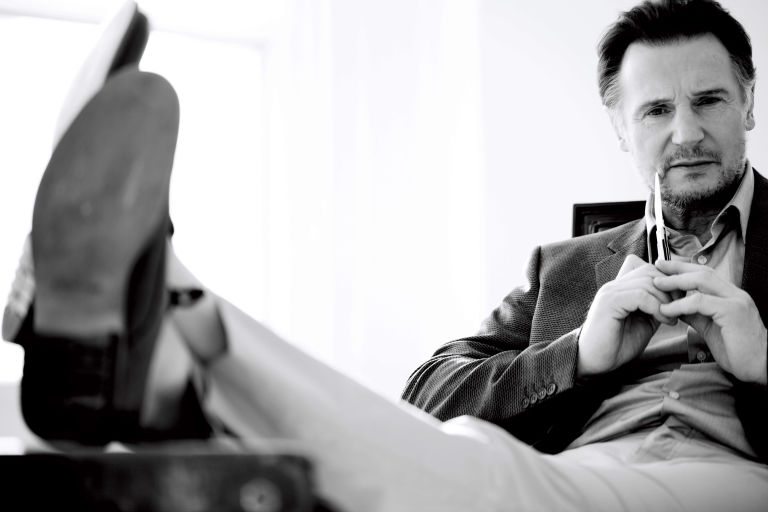
Nigel Parry
One hour earlier,
he tells the story of a motorcycle accident he lived through in 2000.
This riffing off a discussion of fear, of getting knocked out cold in
the ring as a teenager; of the fearsome IRA legend Michael Collins, whom
he played in the movie; fear upon leaving Belfast for Dublin and Dublin
for London; fear upon leaving London for L.A. and L.A. for New York —
none of it sounds really scary. It's just fear as abstraction, fear as
thesis statement. Sounds like a guy looking back and marking time.
I'm
looking at him — ticking off the prisoner in him, the sailor, the
knight, the scientist, the samurai master, the lighthearted commander of
the A-Team, the betrayed husband, the husband betrayer, the priest, the
hero of the oppressed, the Lion God, the Jedi — thinking, This guy is
afraid of only one thing: recounting, revisiting, returning to the most
awful thing. The recent past scares him, which is why, right up to the
moment he starts to tell the following story, he's a little hazy, a
smidge reluctant to detail his memories. That's how it is, right up
until he says:
You have to know, one wet leaf can ruin you.
Th' deer come out of nowhere. Front paws straight up the handlebars.
Look at me. I'm riding like this — you're the deer. We're face-to-face. And your legs are in the spokes.
My
peripheral vision sees this grassy verge with trees, and I'm wanting to
pull over. It was amazing. Not a car in sight. I should have just
slammed on the brakes, put the thing up on its stand, and quit. For some
reason I wanted to get off the road. And of course it wasn't a
horizontal verge at all. It was downhill, twelve feet, and there were a
couple of sapling trees. Me and the bike and the deer slid down. The
bike broke in half. The deer rolled farther down into a ditch, where if I
had gone, no one would have ever found me. I gradually pulled myself up
and got to the side of the road. I took off my jacket, and I sat there
listening to this deer making this awful sound. And I was laughing and I
was crying, and I looked down at this leg, and it was getting bigger,
my jeans were getting tighter, so I knew I'd done something. But I
thought it might not be much. Hoped. This man on a truck, full of muck,
stopped and called the authorities. They got me to a local hospital, and
I got this gorgeous shot of morphine. But I'd broken my pelvis in two
places. My local doctor arranged for transfer to Lenox Hill Hospital in
the city, and when I got there, they had called my wife.
I found out later they'd told her I wouldn't last the night. Well, they never fucking told me that.
She
was shooting, up in Canada, and she came straightaway to the city. So
eight hours later, after the bleeding's stopped, I wake up in the
operating room, before they start the procedure, and it was like a TV
movie: five little heads looking down at me, and among them was my
wife's. And I said, What the fuck are you doing here? She said, They
called me, I drove down from Canada.
Then
afterwards, it's funny, because afterwards — this is weeks afterwards —
Natasha and I, we'd get into an argument. I'd try and replay it back.
And obviously the time is over in some way, it's behind you, but the
chronology of events — but everything I remembered happening was very
large. I couldn't understand something. I said, Darlin', if they told
you I wasn't going to last the night, why'd you not get a priest in? I
said, I know I'm a lapsed Catholic, but at least give me the last rites,
you know? She said, Had I told you, then you would have known that you
might be dying.
More From
Esquire
Advertisement - Continue Reading Below
That's
a fair point, I suppose. I had to get my head round that logic. At the
same time, I coulda died and it woulda been nice to get a little of the
old extreme unction, as it's called. All the oils.
Ten years ago, 2000. Terrible thing.

Charles Eshelman/Getty Images
More From
Esquire
This was exactly halfway
into the interview, when he tells this story. Precisely. And of course,
I'm working backward here, from the end of the story to its start. So
of course I know where that middle is, and Liam Neeson did not. But even
in that moment, this story felt like the middle of things. We both knew
that his accident was over long ago, so far in the past that there was
no longer anything to fear. But he tells it as if it were still a
dreadful thing.
But the
details of the story — one spouse working on a film in Canada, an
accident, a seemingly benign injury, increasing complications, the
last-moment arrival at what might be the moment of death — stand too
close in their telling not to bring to mind the end of Natasha
Richardson, who died after a minor fall during a skiing lesson, while
Neeson was in Toronto, filming Chloe. And just then, it seems, I have the lousy duty of pointing that out.
"It
all sounds so much like your wife's accident," I say. "Ten years. Then
she has this awful accident. You must have felt like all of it had been
reversed."
On the
recording, at this juncture, there is a giant rush of noise in the
already noisy restaurant, like a sudden storm of silverware. In
retrospect, it seems possible that this may be because Liam Neeson —
Zeus-like — shakes his head, or because he refuses to speak. He says, "I
can't. It's ... I'm too vulnerable, Tom. I can't go there."
I
tell him I'm sorry. We pause. "It's brutal," I say. "Just brutal." Then
I pause again. "I'm glad, though, that ..." The sentence goes
unfinished. I can't remember what I was glad about.
Then
he is quiet for a full minute. And oddly, the restaurant grows steadily
quieter, too, on the recording, as if the chatter and gnash of silver
and china simmers down precisely so that weeks later I can hear the
occasional tick of Liam Neeson's tears on a plate, or a saucer, or
whatever it is that sits in front of him as he thinks through what he is
about to say. Tick. Tick. Long pause. Tick. Just like that.
And
then, suddenly, he goes on: "No, no. It's ironic, I know. There I am up
in Canada, doing a movie." Just as she was when he had his accident.
This time, Neeson himself flew with her to New York, also to Lenox Hill
Hospital, where she died.
Liam
Neeson looks right at me then, as if remembering something specific, as
if it just occurred to him, though this cannot be. "I'll tell you one
thing," he says. "I'd been to Montreal maybe twice before. And for some
reason, I thought the city's this size." He holds his hands out in front
of him then, cupped like he is drinking water.
"I
thought that it was this little comfortable little city," he says. "And
for some reason, I thought the hospital that I was in a taxi racing
toward was gonna be a nice little hospital, about twice the size of this
restaurant. But it was this huge, glassy, black place. A Dickensian
place, Tom.
"I walked
into the emergency — it's like seventy, eighty people, broken arms,
black eyes, all that — and for the first time in years, nobody
recognizes me. Not the nurses. The patients. No one. And I've come all
this way, and they won't let me see her. And I'm looking past them,
starting to push — I'm like, Fuck, I know my wife's back there someplace.
I pull out a cell phone — and a security guard comes up, starts saying,
'Sorry, sir, you can't use that in here,' and I'm about to ask him if
he knew me, when he disappears to answer a phone call or something. So I
went outside. It's freezing cold, and I thought, What am I gonna do?
How am I going to get past the security?
"And
I see two nurses, ladies, having a cigarette. I walk up, and luckily
one of them recognizes me. And I'll tell you, I was so fucking grateful —
for the first time in I don't know how long — to be recognized. And
this one, she says, 'Go in that back door there.' She points me to it.
'Make a left. She's in a room there.' So I get there, just in time. And
all these young doctors, who look all of eighteen years of age, they
tell me the worst." He purses his lips, mouth dry. "The worst."
This
is the point where he stops again. He blinks back tears, takes a long
look at the table across from us, where members of Natasha Richardson's
extended family are, coincidentally, having lunch in this same
restaurant. (He and Natasha, this was their place, so it's only a mild
coincidence.) I wait. Again, I tell him how sorry I am. Neeson nods.
That's when I tell him something horrible that happened to me.
He went back to shooting Chloe,
after the funeral. "I just think I was still in a bit of shock," he
says. "But it's kind of a no-brainer to go back to that work. It's a wee
bit of a blur, but I know the tragedy hadn't just really smacked me
yet."
Now the
no-brainer is staying with the work, the good work, as it piles up on
him. "I think I survived by running away some. Running away to work.
Listen, I know how old I am and that I'm just a shoulder injury from
losing roles like the one in Taken. So I stay with the
training, I stay with the work. It's easy enough to plan jobs, to plan a
lot of work. That's effective. But that's the weird thing about grief.
You can't prepare for it. You think you're gonna cry and get it over
with. You make those plans, but they never work.
More From
Esquire
Advertisement - Continue Reading Below
"It hits you in the middle of the night — well, it hits me in the middle of the night. I'm out walking. I'm feeling quite content. And it's like suddenly, boom.
It's like you've just done that in your chest." Here Neeson reaches out
and twists both hands in opposite directions, like he's corkscrewing
two ends of a soda can, reaches toward me so it's clear: This is in his
chest. He shakes his head at the thought of this one thing, this single
hideous bead on the necklace of his life. He speaks as if he were
regarding its cruelty anew, though this too cannot be. He's too smart to
feel singled out by what happened to his wife. Her death, with its
painfully curious timeline — the simple fall, her apparent
clearheadedness, followed by the swift, merciless brain hemorrhage?
Brutal and extraordinary.
Neeson's experience at the hospital — the
mix-up at reception, the chaos of the ER, the arrival of the security
guard? Vivid and, at the same time, banal. Just another hospital story;
everyone has them. This doesn't mean they don't hurt. When he says,
"It's just extraordinary," Neeson is referring to the persistent depth
of pain, the ruinous visitations of grief, even now, two years later.
That stuff is all his very own.

Nigel Parry
More From
Esquire
At the start,
in the first few minutes of the interview, Liam Neeson is chatty about
his upcoming work. He's leaving in two weeks, right after his family
holiday, for Vancouver, to begin shooting The Grey, which he declares to be "Jack London meets Jaws."
He's got a new movie opening soon. Cue the joke. "Yeah," I say,
pretending to check my notes. "What's that movie called? No one seems to
be able to tell me."
"Unknown," he says.
"You too, eh? I thought for sure they would tell you."
He laughs, at me and with me, probably. I cannot be sure.
He's just finished shooting Battleship,
which his costar Brooklyn Decker described to me as a "naval war, with
aliens." Neeson says that's about right. "I'm the admiral of the fleet.
But get this, I was in Belfast this summer, visiting my family, and my
agent kept calling me, saying, Have you read that? Are you ready? And I
said for what now? The shooting isn't till December. And he said no, no,
no. It's Sep-tember. They need you this coming Wednesday! I'd completely let it slip my mind.
"So I spoke to the director, as he was shooting a scene I was supposed to be in, and I thought, Christ, they're working, they really need me already. Anyway, I flew out there, to Hawaii, and I was onboard the USS Missouri
the next day, dressed up in these naval whites, and all these sailors
givin' it this." He gives a firm but unexaggerated salute in the middle
of the restaurant.
Just
as he lowers his hand, a besweatered family approaches and greets him.
He introduces us. This is his wife's family: one of Lynn Redgrave's
daughters. Some former muckety-muck in British politics. Sundry other
cousins. They exchange hugs with him.
It
feels a little like a setup, as if they timed the arrival, and my first
thought was that he might want to include them in our lunch as a means
of not talking — or perhaps talking — about his wife's untimely death.
"Do you want them to join us?" I mutter, as they find their seats near
us. He widens his eyes and shakes his head.
I
pull out my pad and show him a chart I made, graphing his roles. The
y-axis: "power." The x-axis: a measurement of the degree to which the
character appeals to men or women. He laughs at the reaches of it. Aslan
on top, Ethan Frome below. Qui-Gon Jinn to the left, sensitive widower
from Love Actually on the right. My plotting amuses him. "So
many characters," he says. "I can't even remember some of these."
Forgetting, he tells me, is rapidly becoming one of his problems.
Our lunch is set
for 1:00 P.M., but I get there at 11:00, a little worried about a
mix-up or a cancellation. So I sit at the bar of the restaurant and
wait. To pass the time, I take out my pad, draw a schematic of the first
house my parents bought: Westminster Road, Rochester, New York. It
frustrates me that I can remember the location of the powder room, which
I never used as a boy, but I can't remember if there were flower boxes
beneath the windows I often climbed into at night. What the hell can I remember, and why?
I write that very thing at the top of the page because it seems like a
good question to ask Liam Neeson. Below that I make a list of what he's
done. I start a graph of the characters he's played.
Five hundred forty-seven days
before that, Liam Neeson is supposed to meet me for lunch. Same
restaurant, same setup. But just before noon that day in 2009, as I'm
walking to the meeting, he cancels. When I mention this later, Neeson
remembers. "That was you? I'm sorry about that, Tom," he says. "Truly.
That was my mistake. I shouldn't have said yes in the first place. It
was too fresh. I just wasn't ready."
The agenda for that 2009 meeting? Taken, a surprise hit. Clash of the Titans, a surefire popcorn movie. Maybe even some discussion of his continuing role in The Chronicles of Narnia,
since, in essence, he is the voice of God. Liam Neeson has a lot of
work coming up. And while no one is sure if he is ready, there is the
sense that I have to ask him about his wife's death after a seemingly
benign skiing accident.
That
was a year and a half ago. More. In the days leading up to that
meeting, the one that never happened, I dreaded the questions I needed
to ask him.
The 'Taken 3' actor opens up about how he keeps going, even in the face of unbearable loss.
January is the dumping month for movies. Any
film with award aspirations has been released during November and
December to qualify for Oscar nominations, while tentpole pics hit
screens during the blockbuster-making holiday season. Those first few
weeks of the year are when movies that have gotten lousy scores in test
screenings or have been gathering dust on studio shelves get their day,
with the expectation that they’ll hang around theaters no longer than
the popcorn sticking to the floor.
The box office takes the deepest dive on Super Bowl
weekend, so it was a Hail Mary pass when on Friday, Jan. 30, 2009—two
days before nearly 100 million Americans would watch the Pittsburgh
Steelers defeat the Arizona Cardinals—20th Century Fox released Taken.
The action flick had a paltry budget of $25 million and a familiar
revenge plot—former CIA agent Bryan Mills sets out to rescue his
daughter when she’s kidnapped in Paris by a gang of sex traffickers.
“That release date took guts,” says Paul Dergarabedian, a box-office
analyst for Rentrak, a provider of viewership data. “It went against the
grain. What you typically see opening on Super Bowl weekend are
romantic comedies that are aimed at a female audience.” Even the movie’s
star, a then 56-year-old Liam Neeson, had thought that the movie—what
he describes as a “very, very basic, simple storyline”—would stay under
the radar.
It didn’t. Opening on some 3,200 screens, Taken
nabbed the No. 1 spot at the box office, earning a remarkable
$24.7 million. Even Fox Chairman and CEO Jim Gianopulos was astonished.
“We’d screened the film and went, Wow, this is really great,”
Gianopulos says. “The release calendar gets very crowded during the
holiday season, and while we knew what we had, we also knew we needed
word-of-mouth for the movie to get momentum. So we weren’t surprised
that the movie turned out to be a success, but we were very surprised by
the extent of it that first weekend.”
Taken would go on to earn $145 million in
domestic box office receipts and nearly $84 million internationally,
making Liam Neeson an action star and giving rise to a franchise. Three
years later in Taken 2,
protagonist Bryan Mills and his estranged wife (Famke Janssen) are
kidnapped in Istanbul. That film would earn $376 million worldwide. And
on Jan. 9, the final Taken installment opens; this time Mills
is on the run after being framed for the murder of his ex. Neeson, 62,
is one of Hollywood’s highest-paid stars, on track to earn a reported
$50 million for Taken 3. “I laugh at it,” he says. “It’s not
that I laugh at the franchise itself or the position I find myself in. I
just laugh at the ridiculousness of life.”
At 6 feet 4 inches, with the slightly off-kilter
features of the amateur boxer he once was (he broke his nose in a match
at 15), Neeson always had the rough-hewn good looks of an action hero.
If it’s improbable that it took until late middle age for him to achieve
that mantle, Neeson says that timing is just right. Had Taken
come along in his 20s or 30s, he says he would have screwed it up (he
uses a saltier word), and typecasting might have made it difficult for
him to be believable playing the towering historical figures that have
defined him as one of the greatest actors of his generation.
“I certainly wouldn’t have been able to do Schindler's List or Rob Roy or Michael Collins,”
he says. Besides, he adds, “I think that what added to the popularity
of Taken was the fact that I’m an elder guy. I’m a father, so I can
totally empathize with how Bryan Mills reacts when his kid is in danger.
I think that comes across.” What’s left unsaid is that audiences also
know Neeson has dealt with a devastating loss—the death of his wife,
actress Natasha Richardson, after a 2009 skiing accident. “He’s lived
through a lot,” says Olivier Megaton, who directed Taken 2 and Taken 3. “You feel his humanity and his struggle. He knows life can be very hard, bad things happen, and you just keep on fighting.”
In real life, Neeson has some traits you’d never
associate with an action hero. He’s afraid of heights, for one thing.
For another, he had to give up boxing because he blacked out during
bouts. And his idea of a good workout is a 90-minute walk through
Central Park or near his home in upstate New York, a habit he took up as
part of his rehab when he had a near-fatal motorcycle accident in 2000.
(But make no mistake, these are power walks. “I’ve done some of those
walks with Liam,” says actor Aidan Quinn, a good friend and godfather to
Neeson’s younger son, Daniel. “And the man moves; his stride is fast.
These are deep-in-your-adductors, heart-pounding walks.”) And Neeson is a
voracious reader who’s always juggling a few books. He’s reading The Richard Burton Diaries and a crime novel by the British writer John Burdett, plus a thriller by Scandinavian author Kristina Ohlsson.
Introverted and bookish, Neeson might be a very
different person from Bryan Mills, but, says Janssen, “If you were in
danger, Liam is the person you’d want to have rescuing you.” Actress
Laura Linney agrees. She and Neeson are close friends—she starred
opposite him in the films Kinsey, The Other Man and Love Actually, and on Broadway in The Crucible.
“I always feel safe when I’m around Liam,” Linney says. “Some of that
is his strength and masculinity and his great looks. But beyond those
superficial reasons are deeper ones, like his devotion as a friend. It’s
not the big heroic gestures; it’s the little ones. Liam keeps in touch;
he’s aware of what you’re going through. You feel appreciated by him.”
When Linney wed, just four months after Richardson’s death, Neeson
walked her down the aisle.
Women in large numbers are smitten with Neeson. A big part of the success of the Taken
movies, says Gianopulos, is that they draw a far more sizable female
audience than is typical of action pictures. But to paraphrase a
sentiment first applied to James Bond, if women want to be around
Neeson, men want to be him. “There are some leading men who piss other
men off and make them angry, jealous and uncomfortable,” Linney says.
“Liam isn’t one of them, and I think that’s because he has an innate
modesty and an innate decency that’s comforting. Everyone—men and
women—feel better when he’s around.” That’s certainly true for Megaton.
“The first time I met Liam,” he recalls, “he said, ‘If you need me, I’m
here to protect you.’ When you make a movie, you have a million problems
a day, and Liam wanted to be there for me.”
In fact, men’s admiration for Neeson can undermine his
ability to play a convincing tough guy in real life. Maggie Grace, who
portrays Neeson’s daughter in the Taken trilogy, was 24 when
she made the first film and, she says, “trying to get over a boy who
broke my heart.” Neeson, with a combination of humor and paternal
concern, called the guy, leaving a version of the speech he made famous
in Taken: “I have a very particular set of skills, skills I
have acquired over a very long career. Skills that make me a nightmare
for people like you…. I will look for you, I will find you, and I will
kill you.”
“We tailored the speech to scare the living beejesus out
of the guy,” Grace says. “But it backfired when he figured out it was
really Liam and not an amazing Liam impersonator. He was so excited.
‘Liam Neeson called my office! That’s the coolest thing ever! Do you
have a video of it?’ Liam and I laughed so hard.” Still, even if that
prank call failed to intimidate, “What girl,” says Grace, “doesn’t want a
father figure like Liam freakin’ Neeson to watch out for her now and then?”
Neeson has made some 70 movies, 15 in the last three
years alone. In April he stars as an aging hit man in Run All Night, has
a small part in the comedy Ted 2, and then the title role in A Monster Calls, an adaptation of the children’s fantasy novel. Clearly, even if that reported $50 million Taken 3
windfall is off by a few mil, he’s not doing back-to-back flicks for
the paycheck. Instead Neeson works nearly nonstop because, he says, “I
absolutely adore the business” and because people ask him to. “I get a
kick out of complete strangers getting in touch with my agent or sending
me a script that they want me to be in,” he says. “There’s a part of me
that’s like the little boy in a toy shop thinking, Oh, I want to have that, I want to have that, and I want that. Can I do both those jobs? Can I do all three? And you know, I also want to please everybody and do it all.”
That work ethic was forged in Neeson’s modest upbringing
in the Northern Ireland town of Ballymena. “I’m not going to give you
some sob story about how we were at death’s door because of poverty,” he
says, “but we were very, very working class. My mother worked as an
assistant cook. My father had, let’s say, long periods of unemployment
and eventually became a grammar school custodian. So money was tight.”
Neeson began working on construction sites when he was 15. “You got paid
on a Thursday, and you came in and handed your wages to your mom,” he
says. “It was a great feeling of achievement. It does make you feel
grown up. It does make you feel responsible.
You realize your place in the world when you have a job, and when you
get paid in that little brown envelope, it connects you to the rest of
working humanity, and that just felt very, very comforting.”
He learned another lesson about humanity from his
grandfather, a steam-engine driver. Once he retired, he’d scan the
newspaper every morning to see who had died. “Inevitably he’d find some
name, say O’Rafferty, and he’d think, I wonder if that was the guy I
worked with 30 years ago,” Neeson says. “He’d find out where this
gentleman was being buried, and he’d walk there. He was a fantastic
walker. When I was 6 or 7 or 8, he’d sometimes make me go with him, and
we’d walk for what seemed like miles. I remember standing around those
graves, just the priest, an altar boy, my grandfather and me while some
prayers were said. That became my grandfather’s later-life vocation. He
believed every life means something. Like Biff Loman’s mother says to her son in Arthur Miller’s Death of a Salesman, ‘Attention must be paid to such a man. Attention must be paid.’ ”
Neeson began acting when he was 11, attracted to the
stage because a girl he liked who had “skin of alabaster and cherry-red
lips” was starring in the school play. He kept acting in school
productions and later attended Queen’s University in Belfast. Interested
in becoming a teacher, he took classes elsewhere, but those studies
didn’t hold his interest, and he dropped out to pursue acting. He joined
the Lyric Players’ Theatre in Belfast and two years later began
performing with Dublin’s famed Abbey Theatre. At 28 he got his first
high-profile movie role, Sir Gawain in Excalibur.
The 1981 film starred Helen Mirren, and the two began a romance that
lasted four years. “I fell in love with Helen Mirren,” Neeson recalled
on 60 Minutes. “Oh my God. Can you imagine riding horses in
shiny suits of armor, having sword fights and stuff, and you’re falling
in love with Helen Mirren? It doesn’t get any better than that.”
After that action fantasy, Neeson had supporting roles in movies such as The Mission, an 18th-century adventure starring Robert De Niro, and played opposite Cher in Suspect and Diane Keaton in The Good Mother.
Fans of Sonny Crockett and Rico Tubbs might recall Neeson’s portrayal
of a former member of the Irish Republican Army in a 1986 Miami Vice episode.
His first starring role was the 1990 fantasy thriller Darkman, and in 1993 he was cast as Oskar Schindler in the masterful Steven Spielberg Holocaust drama Schindler’s List,
which led to an Academy Award nomination. But his performance left him
dissatisfied. (“I thought the film was quite extraordinary except for
myself,” he has said. “I didn’t own the part. I didn’t see enough of me
in there.”) He would go on to win critical raves playing an 18th-century
Scottish Highlander in Rob Roy, the Irish revolutionary Michael Collins and sex researcher Alfred Kinsey in Kinsey.
There were lots of other high-profile roles: in Martin Scorsese’s Gangs Of New York and Woody Allen’s Husbands And Wives, in Star Wars: Episode I - The Phantom Menace and Batman Begins. Straddling genres, he did Westerns (Seraphim Falls) and comedies (A Million Ways to Die in the West and Gun Shy), battled the bad guys on a submarine (K-19: The Widowmaker) and a plane (Non-Stop), and fought off wolves (The Grey) and deviant drug lords (A Walk Among the Tombstones). Leaving his snarling demeanor aside, he voiced Aslan the lion in the Narnia movies, and the good cop and bad cop in The Lego Movie.
Neeson says when he catches some of his old movies as he’s flipping through TV channels, he winces. In Excalibur,
for example, “I’m chewing up the scenery,” he says, then adds, “God
knows I’ve done some not-very-good movies. But it’s always a learning
curve, always. I always try and come away from the experience having learned something or some things.”
His more recent acting is less likely to make him cringe. “Overall I
think I’m a much better actor now that I’m older,” he says. “I feel very
comfortable in front of a lens and nothing throws me off. Be I in a
suit of armor with a false beard, on horseback being chased by dragons
or looking at a Russian terrorist: It’s OK; this is the story. This is
what I have to do. And I like to think I’ve minimalized my acting over
the years, meaning I’ve achieved something whereby less is more.”
Megaton says Neeson is very precise in his acting. “He
likes to go very far into the realities of his character,” the director
says. “We had an ex-CIA agent consulting on Taken 3, and Liam would ask lots of questions, like how he’d walk into a room when he knew that inside there were people with weapons.”
There’s a favorite Samuel Beckett quote that Neeson and
his late wife shared: “Ever tried. Ever failed. No matter. Try again.
Fail again. Fail better.” Neeson and Richardson met in 1992 after being
cast in the Eugene O’Neill play Anna Christie on Broadway. “She and I were like Astaire and Rogers,” Neeson told 60 Minutes.
“We had just this wonderful kind of dance, free dance on stage every
night, you know?” They wed in July 1994 at the couple’s farmhouse in
upstate New York; their son Micheál was born in 1995 and Daniel the
following year.
“They were a fantastic couple,” Quinn says. “Natasha was
always organizing some great gathering at their place. The parties they
used to have once or twice a year were legendary. Natasha would take
care of every detail. She was a great chef; there would always be great
wine and spirits, good music. She loved bringing people together.
Natasha had her shy side, but she was much more of an extrovert than
Liam, and when it came to socializing, she was the motor.”
Whenever Neeson or Richardson did theater, they kept the
Beckett quote in their dressing room as inspiration. “You’ve come
offstage,” Neeson says, “you’ve done a lousy performance for whatever
reason, and you get a chance to go on stage the next night and the night
after that for four or five months. You make it better, but you have to
be there. You have to come back to the plate again. You have to keep
always coming to the plate.”
For Neeson the quote resonated beyond acting. “You think
all things are lost, but it’s not lost,” he says. “There’s always
hope.” It was a belief he needed to draw upon in March 2009. Neeson was
in Toronto filming the movie Chloe
when Richardson called from a Quebec ski resort where she was on
vacation with Micheál. She’d fallen and hit her head coming down a
beginner slope. “Oh, darling,” she said to Neeson, “I’ve taken a tumble
in the snow.”
In fact, although she didn’t know it, Richardson had
suffered a traumatic brain injury. By the time Neeson reached the
hospital in Montreal, X-rays showed she was brain-dead.
The couple had a pact: If either of them was ever in a
vegetative state, the other would pull the plug. Neeson gave the
directive. Richardson’s heart, kidneys and liver were donated, “so,
she’s keeping three people alive,” Neeson says. “And I think she would
be very thrilled and pleased by that.”
Days after Richardson’s funeral, he was back on the set of Chloe. He wanted, he says, to be a good example to his sons, then ages 13 and 12. “You just say to yourself, You can’t fall apart,”
Neeson says. “And you just can’t. You’re responsible for two lives. Of
course, it’s a tragedy, and life throws awful curveballs at you
sometimes, but you have to cope.”
He gained strength, he says, from his family and from Richardson’s,
including her mother, actress Vanessa Redgrave, with whom he’s very
close. “You could ask them to do anything, and it would be done,” he
says. “They stopped their lives to look after us. I was very, very
lucky.”
The epitaph on Richardson’s tombstone is “Cast your
bread upon the water, and it will be returned tenfold.” Neeson is, by
the account of his friends, extraordinarily generous. Aidan Quinn says
he has made large contributions to the school that Quinn’s daughter, who
is autistic, attended. When Maggie Grace made her Broadway debut in Picnic
in 2013, Neeson was there. It was the same theater where Neeson and
Richardson had performed. If it was painful for him, he didn’t show it.
“He came backstage, and everyone was so excited to see him,” Grace says.
“He still remembered funny stories and the names of the folks who had
been there when he and Natasha were in Anna Christie.”
Jules Daly, who was the producer on two of Neeson’s films—The Grey and The A-Team—sums
up his appeal. “Liam’s like the last man on earth,” she says. “He’s
chivalrous, but he’s a great supporter of women. He’s got your back.
This is a man who looks you in the eye when he asks you how you are. He
really, truly cares. He remembers things about your family, he wants to
see pictures of your kids, and he remembers the names of everyone on the
crew, down to the grips. Liam defines authentic.”
The 'Taken 3' actor opens up about how he keeps going, even in the face of unbearable loss.
January is the dumping month for movies. Any
film with award aspirations has been released during November and
December to qualify for Oscar nominations, while tentpole pics hit
screens during the blockbuster-making holiday season. Those first few
weeks of the year are when movies that have gotten lousy scores in test
screenings or have been gathering dust on studio shelves get their day,
with the expectation that they’ll hang around theaters no longer than
the popcorn sticking to the floor.
The box office takes the deepest dive on Super Bowl
weekend, so it was a Hail Mary pass when on Friday, Jan. 30, 2009—two
days before nearly 100 million Americans would watch the Pittsburgh
Steelers defeat the Arizona Cardinals—20th Century Fox released Taken.
The action flick had a paltry budget of $25 million and a familiar
revenge plot—former CIA agent Bryan Mills sets out to rescue his
daughter when she’s kidnapped in Paris by a gang of sex traffickers.
“That release date took guts,” says Paul Dergarabedian, a box-office
analyst for Rentrak, a provider of viewership data. “It went against the
grain. What you typically see opening on Super Bowl weekend are
romantic comedies that are aimed at a female audience.” Even the movie’s
star, a then 56-year-old Liam Neeson, had thought that the movie—what
he describes as a “very, very basic, simple storyline”—would stay under
the radar.
It didn’t. Opening on some 3,200 screens, Taken
nabbed the No. 1 spot at the box office, earning a remarkable
$24.7 million. Even Fox Chairman and CEO Jim Gianopulos was astonished.
“We’d screened the film and went, Wow, this is really great,”
Gianopulos says. “The release calendar gets very crowded during the
holiday season, and while we knew what we had, we also knew we needed
word-of-mouth for the movie to get momentum. So we weren’t surprised
that the movie turned out to be a success, but we were very surprised by
the extent of it that first weekend.”
Taken would go on to earn $145 million in
domestic box office receipts and nearly $84 million internationally,
making Liam Neeson an action star and giving rise to a franchise. Three
years later in Taken 2,
protagonist Bryan Mills and his estranged wife (Famke Janssen) are
kidnapped in Istanbul. That film would earn $376 million worldwide. And
on Jan. 9, the final Taken installment opens; this time Mills
is on the run after being framed for the murder of his ex. Neeson, 62,
is one of Hollywood’s highest-paid stars, on track to earn a reported
$50 million for Taken 3. “I laugh at it,” he says. “It’s not
that I laugh at the franchise itself or the position I find myself in. I
just laugh at the ridiculousness of life.”
At 6 feet 4 inches, with the slightly off-kilter
features of the amateur boxer he once was (he broke his nose in a match
at 15), Neeson always had the rough-hewn good looks of an action hero.
If it’s improbable that it took until late middle age for him to achieve
that mantle, Neeson says that timing is just right. Had Taken
come along in his 20s or 30s, he says he would have screwed it up (he
uses a saltier word), and typecasting might have made it difficult for
him to be believable playing the towering historical figures that have
defined him as one of the greatest actors of his generation.
“I certainly wouldn’t have been able to do Schindler's List or Rob Roy or Michael Collins,”
he says. Besides, he adds, “I think that what added to the popularity
of Taken was the fact that I’m an elder guy. I’m a father, so I can
totally empathize with how Bryan Mills reacts when his kid is in danger.
I think that comes across.” What’s left unsaid is that audiences also
know Neeson has dealt with a devastating loss—the death of his wife,
actress Natasha Richardson, after a 2009 skiing accident. “He’s lived
through a lot,” says Olivier Megaton, who directed Taken 2 and Taken 3. “You feel his humanity and his struggle. He knows life can be very hard, bad things happen, and you just keep on fighting.”
In real life, Neeson has some traits you’d never
associate with an action hero. He’s afraid of heights, for one thing.
For another, he had to give up boxing because he blacked out during
bouts. And his idea of a good workout is a 90-minute walk through
Central Park or near his home in upstate New York, a habit he took up as
part of his rehab when he had a near-fatal motorcycle accident in 2000.
(But make no mistake, these are power walks. “I’ve done some of those
walks with Liam,” says actor Aidan Quinn, a good friend and godfather to
Neeson’s younger son, Daniel. “And the man moves; his stride is fast.
These are deep-in-your-adductors, heart-pounding walks.”) And Neeson is a
voracious reader who’s always juggling a few books. He’s reading The Richard Burton Diaries and a crime novel by the British writer John Burdett, plus a thriller by Scandinavian author Kristina Ohlsson.
Introverted and bookish, Neeson might be a very
different person from Bryan Mills, but, says Janssen, “If you were in
danger, Liam is the person you’d want to have rescuing you.” Actress
Laura Linney agrees. She and Neeson are close friends—she starred
opposite him in the films Kinsey, The Other Man and Love Actually, and on Broadway in The Crucible.
“I always feel safe when I’m around Liam,” Linney says. “Some of that
is his strength and masculinity and his great looks. But beyond those
superficial reasons are deeper ones, like his devotion as a friend. It’s
not the big heroic gestures; it’s the little ones. Liam keeps in touch;
he’s aware of what you’re going through. You feel appreciated by him.”
When Linney wed, just four months after Richardson’s death, Neeson
walked her down the aisle.
Women in large numbers are smitten with Neeson. A big part of the success of the Taken
movies, says Gianopulos, is that they draw a far more sizable female
audience than is typical of action pictures. But to paraphrase a
sentiment first applied to James Bond, if women want to be around
Neeson, men want to be him. “There are some leading men who piss other
men off and make them angry, jealous and uncomfortable,” Linney says.
“Liam isn’t one of them, and I think that’s because he has an innate
modesty and an innate decency that’s comforting. Everyone—men and
women—feel better when he’s around.” That’s certainly true for Megaton.
“The first time I met Liam,” he recalls, “he said, ‘If you need me, I’m
here to protect you.’ When you make a movie, you have a million problems
a day, and Liam wanted to be there for me.”
In fact, men’s admiration for Neeson can undermine his
ability to play a convincing tough guy in real life. Maggie Grace, who
portrays Neeson’s daughter in the Taken trilogy, was 24 when
she made the first film and, she says, “trying to get over a boy who
broke my heart.” Neeson, with a combination of humor and paternal
concern, called the guy, leaving a version of the speech he made famous
in Taken: “I have a very particular set of skills, skills I
have acquired over a very long career. Skills that make me a nightmare
for people like you…. I will look for you, I will find you, and I will
kill you.”
“We tailored the speech to scare the living beejesus out
of the guy,” Grace says. “But it backfired when he figured out it was
really Liam and not an amazing Liam impersonator. He was so excited.
‘Liam Neeson called my office! That’s the coolest thing ever! Do you
have a video of it?’ Liam and I laughed so hard.” Still, even if that
prank call failed to intimidate, “What girl,” says Grace, “doesn’t want a
father figure like Liam freakin’ Neeson to watch out for her now and then?”
Neeson has made some 70 movies, 15 in the last three
years alone. In April he stars as an aging hit man in Run All Night, has
a small part in the comedy Ted 2, and then the title role in A Monster Calls, an adaptation of the children’s fantasy novel. Clearly, even if that reported $50 million Taken 3
windfall is off by a few mil, he’s not doing back-to-back flicks for
the paycheck. Instead Neeson works nearly nonstop because, he says, “I
absolutely adore the business” and because people ask him to. “I get a
kick out of complete strangers getting in touch with my agent or sending
me a script that they want me to be in,” he says. “There’s a part of me
that’s like the little boy in a toy shop thinking, Oh, I want to have that, I want to have that, and I want that. Can I do both those jobs? Can I do all three? And you know, I also want to please everybody and do it all.”
That work ethic was forged in Neeson’s modest upbringing
in the Northern Ireland town of Ballymena. “I’m not going to give you
some sob story about how we were at death’s door because of poverty,” he
says, “but we were very, very working class. My mother worked as an
assistant cook. My father had, let’s say, long periods of unemployment
and eventually became a grammar school custodian. So money was tight.”
Neeson began working on construction sites when he was 15. “You got paid
on a Thursday, and you came in and handed your wages to your mom,” he
says. “It was a great feeling of achievement. It does make you feel
grown up. It does make you feel responsible.
You realize your place in the world when you have a job, and when you
get paid in that little brown envelope, it connects you to the rest of
working humanity, and that just felt very, very comforting.”
He learned another lesson about humanity from his
grandfather, a steam-engine driver. Once he retired, he’d scan the
newspaper every morning to see who had died. “Inevitably he’d find some
name, say O’Rafferty, and he’d think, I wonder if that was the guy I
worked with 30 years ago,” Neeson says. “He’d find out where this
gentleman was being buried, and he’d walk there. He was a fantastic
walker. When I was 6 or 7 or 8, he’d sometimes make me go with him, and
we’d walk for what seemed like miles. I remember standing around those
graves, just the priest, an altar boy, my grandfather and me while some
prayers were said. That became my grandfather’s later-life vocation. He
believed every life means something. Like Biff Loman’s mother says to her son in Arthur Miller’s Death of a Salesman, ‘Attention must be paid to such a man. Attention must be paid.’ ”
Neeson began acting when he was 11, attracted to the
stage because a girl he liked who had “skin of alabaster and cherry-red
lips” was starring in the school play. He kept acting in school
productions and later attended Queen’s University in Belfast. Interested
in becoming a teacher, he took classes elsewhere, but those studies
didn’t hold his interest, and he dropped out to pursue acting. He joined
the Lyric Players’ Theatre in Belfast and two years later began
performing with Dublin’s famed Abbey Theatre. At 28 he got his first
high-profile movie role, Sir Gawain in Excalibur.
The 1981 film starred Helen Mirren, and the two began a romance that
lasted four years. “I fell in love with Helen Mirren,” Neeson recalled
on 60 Minutes. “Oh my God. Can you imagine riding horses in
shiny suits of armor, having sword fights and stuff, and you’re falling
in love with Helen Mirren? It doesn’t get any better than that.”
After that action fantasy, Neeson had supporting roles in movies such as The Mission, an 18th-century adventure starring Robert De Niro, and played opposite Cher in Suspect and Diane Keaton in The Good Mother.
Fans of Sonny Crockett and Rico Tubbs might recall Neeson’s portrayal
of a former member of the Irish Republican Army in a 1986 Miami Vice episode.
His first starring role was the 1990 fantasy thriller Darkman, and in 1993 he was cast as Oskar Schindler in the masterful Steven Spielberg Holocaust drama Schindler’s List,
which led to an Academy Award nomination. But his performance left him
dissatisfied. (“I thought the film was quite extraordinary except for
myself,” he has said. “I didn’t own the part. I didn’t see enough of me
in there.”) He would go on to win critical raves playing an 18th-century
Scottish Highlander in Rob Roy, the Irish revolutionary Michael Collins and sex researcher Alfred Kinsey in Kinsey.
There were lots of other high-profile roles: in Martin Scorsese’s Gangs Of New York and Woody Allen’s Husbands And Wives, in Star Wars: Episode I - The Phantom Menace and Batman Begins. Straddling genres, he did Westerns (Seraphim Falls) and comedies (A Million Ways to Die in the West and Gun Shy), battled the bad guys on a submarine (K-19: The Widowmaker) and a plane (Non-Stop), and fought off wolves (The Grey) and deviant drug lords (A Walk Among the Tombstones). Leaving his snarling demeanor aside, he voiced Aslan the lion in the Narnia movies, and the good cop and bad cop in The Lego Movie.
Neeson says when he catches some of his old movies as he’s flipping through TV channels, he winces. In Excalibur,
for example, “I’m chewing up the scenery,” he says, then adds, “God
knows I’ve done some not-very-good movies. But it’s always a learning
curve, always. I always try and come away from the experience having learned something or some things.”
His more recent acting is less likely to make him cringe. “Overall I
think I’m a much better actor now that I’m older,” he says. “I feel very
comfortable in front of a lens and nothing throws me off. Be I in a
suit of armor with a false beard, on horseback being chased by dragons
or looking at a Russian terrorist: It’s OK; this is the story. This is
what I have to do. And I like to think I’ve minimalized my acting over
the years, meaning I’ve achieved something whereby less is more.”
Megaton says Neeson is very precise in his acting. “He
likes to go very far into the realities of his character,” the director
says. “We had an ex-CIA agent consulting on Taken 3, and Liam would ask lots of questions, like how he’d walk into a room when he knew that inside there were people with weapons.”
There’s a favorite Samuel Beckett quote that Neeson and
his late wife shared: “Ever tried. Ever failed. No matter. Try again.
Fail again. Fail better.” Neeson and Richardson met in 1992 after being
cast in the Eugene O’Neill play Anna Christie on Broadway. “She and I were like Astaire and Rogers,” Neeson told 60 Minutes.
“We had just this wonderful kind of dance, free dance on stage every
night, you know?” They wed in July 1994 at the couple’s farmhouse in
upstate New York; their son Micheál was born in 1995 and Daniel the
following year.
“They were a fantastic couple,” Quinn says. “Natasha was
always organizing some great gathering at their place. The parties they
used to have once or twice a year were legendary. Natasha would take
care of every detail. She was a great chef; there would always be great
wine and spirits, good music. She loved bringing people together.
Natasha had her shy side, but she was much more of an extrovert than
Liam, and when it came to socializing, she was the motor.”
Whenever Neeson or Richardson did theater, they kept the
Beckett quote in their dressing room as inspiration. “You’ve come
offstage,” Neeson says, “you’ve done a lousy performance for whatever
reason, and you get a chance to go on stage the next night and the night
after that for four or five months. You make it better, but you have to
be there. You have to come back to the plate again. You have to keep
always coming to the plate.”
For Neeson the quote resonated beyond acting. “You think
all things are lost, but it’s not lost,” he says. “There’s always
hope.” It was a belief he needed to draw upon in March 2009. Neeson was
in Toronto filming the movie Chloe
when Richardson called from a Quebec ski resort where she was on
vacation with Micheál. She’d fallen and hit her head coming down a
beginner slope. “Oh, darling,” she said to Neeson, “I’ve taken a tumble
in the snow.”
In fact, although she didn’t know it, Richardson had
suffered a traumatic brain injury. By the time Neeson reached the
hospital in Montreal, X-rays showed she was brain-dead.
The couple had a pact: If either of them was ever in a
vegetative state, the other would pull the plug. Neeson gave the
directive. Richardson’s heart, kidneys and liver were donated, “so,
she’s keeping three people alive,” Neeson says. “And I think she would
be very thrilled and pleased by that.”
Days after Richardson’s funeral, he was back on the set of Chloe. He wanted, he says, to be a good example to his sons, then ages 13 and 12. “You just say to yourself, You can’t fall apart,”
Neeson says. “And you just can’t. You’re responsible for two lives. Of
course, it’s a tragedy, and life throws awful curveballs at you
sometimes, but you have to cope.”
He gained strength, he says, from his family and from Richardson’s,
including her mother, actress Vanessa Redgrave, with whom he’s very
close. “You could ask them to do anything, and it would be done,” he
says. “They stopped their lives to look after us. I was very, very
lucky.”
The epitaph on Richardson’s tombstone is “Cast your
bread upon the water, and it will be returned tenfold.” Neeson is, by
the account of his friends, extraordinarily generous. Aidan Quinn says
he has made large contributions to the school that Quinn’s daughter, who
is autistic, attended. When Maggie Grace made her Broadway debut in Picnic
in 2013, Neeson was there. It was the same theater where Neeson and
Richardson had performed. If it was painful for him, he didn’t show it.
“He came backstage, and everyone was so excited to see him,” Grace says.
“He still remembered funny stories and the names of the folks who had
been there when he and Natasha were in Anna Christie.”
Jules Daly, who was the producer on two of Neeson’s films—The Grey and The A-Team—sums
up his appeal. “Liam’s like the last man on earth,” she says. “He’s
chivalrous, but he’s a great supporter of women. He’s got your back.
This is a man who looks you in the eye when he asks you how you are. He
really, truly cares. He remembers things about your family, he wants to
see pictures of your kids, and he remembers the names of everyone on the
crew, down to the grips. Liam defines authentic.”
The 'Taken 3' actor opens up about how he keeps going, even in the face of unbearable loss.
January is the dumping month for movies. Any
film with award aspirations has been released during November and
December to qualify for Oscar nominations, while tentpole pics hit
screens during the blockbuster-making holiday season. Those first few
weeks of the year are when movies that have gotten lousy scores in test
screenings or have been gathering dust on studio shelves get their day,
with the expectation that they’ll hang around theaters no longer than
the popcorn sticking to the floor.
The box office takes the deepest dive on Super Bowl
weekend, so it was a Hail Mary pass when on Friday, Jan. 30, 2009—two
days before nearly 100 million Americans would watch the Pittsburgh
Steelers defeat the Arizona Cardinals—20th Century Fox released Taken.
The action flick had a paltry budget of $25 million and a familiar
revenge plot—former CIA agent Bryan Mills sets out to rescue his
daughter when she’s kidnapped in Paris by a gang of sex traffickers.
“That release date took guts,” says Paul Dergarabedian, a box-office
analyst for Rentrak, a provider of viewership data. “It went against the
grain. What you typically see opening on Super Bowl weekend are
romantic comedies that are aimed at a female audience.” Even the movie’s
star, a then 56-year-old Liam Neeson, had thought that the movie—what
he describes as a “very, very basic, simple storyline”—would stay under
the radar.
It didn’t. Opening on some 3,200 screens, Taken
nabbed the No. 1 spot at the box office, earning a remarkable
$24.7 million. Even Fox Chairman and CEO Jim Gianopulos was astonished.
“We’d screened the film and went, Wow, this is really great,”
Gianopulos says. “The release calendar gets very crowded during the
holiday season, and while we knew what we had, we also knew we needed
word-of-mouth for the movie to get momentum. So we weren’t surprised
that the movie turned out to be a success, but we were very surprised by
the extent of it that first weekend.”
Taken would go on to earn $145 million in
domestic box office receipts and nearly $84 million internationally,
making Liam Neeson an action star and giving rise to a franchise. Three
years later in Taken 2,
protagonist Bryan Mills and his estranged wife (Famke Janssen) are
kidnapped in Istanbul. That film would earn $376 million worldwide. And
on Jan. 9, the final Taken installment opens; this time Mills
is on the run after being framed for the murder of his ex. Neeson, 62,
is one of Hollywood’s highest-paid stars, on track to earn a reported
$50 million for Taken 3. “I laugh at it,” he says. “It’s not
that I laugh at the franchise itself or the position I find myself in. I
just laugh at the ridiculousness of life.”
At 6 feet 4 inches, with the slightly off-kilter
features of the amateur boxer he once was (he broke his nose in a match
at 15), Neeson always had the rough-hewn good looks of an action hero.
If it’s improbable that it took until late middle age for him to achieve
that mantle, Neeson says that timing is just right. Had Taken
come along in his 20s or 30s, he says he would have screwed it up (he
uses a saltier word), and typecasting might have made it difficult for
him to be believable playing the towering historical figures that have
defined him as one of the greatest actors of his generation.
“I certainly wouldn’t have been able to do Schindler's List or Rob Roy or Michael Collins,”
he says. Besides, he adds, “I think that what added to the popularity
of Taken was the fact that I’m an elder guy. I’m a father, so I can
totally empathize with how Bryan Mills reacts when his kid is in danger.
I think that comes across.” What’s left unsaid is that audiences also
know Neeson has dealt with a devastating loss—the death of his wife,
actress Natasha Richardson, after a 2009 skiing accident. “He’s lived
through a lot,” says Olivier Megaton, who directed Taken 2 and Taken 3. “You feel his humanity and his struggle. He knows life can be very hard, bad things happen, and you just keep on fighting.”
In real life, Neeson has some traits you’d never
associate with an action hero. He’s afraid of heights, for one thing.
For another, he had to give up boxing because he blacked out during
bouts. And his idea of a good workout is a 90-minute walk through
Central Park or near his home in upstate New York, a habit he took up as
part of his rehab when he had a near-fatal motorcycle accident in 2000.
(But make no mistake, these are power walks. “I’ve done some of those
walks with Liam,” says actor Aidan Quinn, a good friend and godfather to
Neeson’s younger son, Daniel. “And the man moves; his stride is fast.
These are deep-in-your-adductors, heart-pounding walks.”) And Neeson is a
voracious reader who’s always juggling a few books. He’s reading The Richard Burton Diaries and a crime novel by the British writer John Burdett, plus a thriller by Scandinavian author Kristina Ohlsson.
Introverted and bookish, Neeson might be a very
different person from Bryan Mills, but, says Janssen, “If you were in
danger, Liam is the person you’d want to have rescuing you.” Actress
Laura Linney agrees. She and Neeson are close friends—she starred
opposite him in the films Kinsey, The Other Man and Love Actually, and on Broadway in The Crucible.
“I always feel safe when I’m around Liam,” Linney says. “Some of that
is his strength and masculinity and his great looks. But beyond those
superficial reasons are deeper ones, like his devotion as a friend. It’s
not the big heroic gestures; it’s the little ones. Liam keeps in touch;
he’s aware of what you’re going through. You feel appreciated by him.”
When Linney wed, just four months after Richardson’s death, Neeson
walked her down the aisle.
Women in large numbers are smitten with Neeson. A big part of the success of the Taken
movies, says Gianopulos, is that they draw a far more sizable female
audience than is typical of action pictures. But to paraphrase a
sentiment first applied to James Bond, if women want to be around
Neeson, men want to be him. “There are some leading men who piss other
men off and make them angry, jealous and uncomfortable,” Linney says.
“Liam isn’t one of them, and I think that’s because he has an innate
modesty and an innate decency that’s comforting. Everyone—men and
women—feel better when he’s around.” That’s certainly true for Megaton.
“The first time I met Liam,” he recalls, “he said, ‘If you need me, I’m
here to protect you.’ When you make a movie, you have a million problems
a day, and Liam wanted to be there for me.”
In fact, men’s admiration for Neeson can undermine his
ability to play a convincing tough guy in real life. Maggie Grace, who
portrays Neeson’s daughter in the Taken trilogy, was 24 when
she made the first film and, she says, “trying to get over a boy who
broke my heart.” Neeson, with a combination of humor and paternal
concern, called the guy, leaving a version of the speech he made famous
in Taken: “I have a very particular set of skills, skills I
have acquired over a very long career. Skills that make me a nightmare
for people like you…. I will look for you, I will find you, and I will
kill you.”
“We tailored the speech to scare the living beejesus out
of the guy,” Grace says. “But it backfired when he figured out it was
really Liam and not an amazing Liam impersonator. He was so excited.
‘Liam Neeson called my office! That’s the coolest thing ever! Do you
have a video of it?’ Liam and I laughed so hard.” Still, even if that
prank call failed to intimidate, “What girl,” says Grace, “doesn’t want a
father figure like Liam freakin’ Neeson to watch out for her now and then?”
Neeson has made some 70 movies, 15 in the last three
years alone. In April he stars as an aging hit man in Run All Night, has
a small part in the comedy Ted 2, and then the title role in A Monster Calls, an adaptation of the children’s fantasy novel. Clearly, even if that reported $50 million Taken 3
windfall is off by a few mil, he’s not doing back-to-back flicks for
the paycheck. Instead Neeson works nearly nonstop because, he says, “I
absolutely adore the business” and because people ask him to. “I get a
kick out of complete strangers getting in touch with my agent or sending
me a script that they want me to be in,” he says. “There’s a part of me
that’s like the little boy in a toy shop thinking, Oh, I want to have that, I want to have that, and I want that. Can I do both those jobs? Can I do all three? And you know, I also want to please everybody and do it all.”
That work ethic was forged in Neeson’s modest upbringing
in the Northern Ireland town of Ballymena. “I’m not going to give you
some sob story about how we were at death’s door because of poverty,” he
says, “but we were very, very working class. My mother worked as an
assistant cook. My father had, let’s say, long periods of unemployment
and eventually became a grammar school custodian. So money was tight.”
Neeson began working on construction sites when he was 15. “You got paid
on a Thursday, and you came in and handed your wages to your mom,” he
says. “It was a great feeling of achievement. It does make you feel
grown up. It does make you feel responsible.
You realize your place in the world when you have a job, and when you
get paid in that little brown envelope, it connects you to the rest of
working humanity, and that just felt very, very comforting.”
He learned another lesson about humanity from his
grandfather, a steam-engine driver. Once he retired, he’d scan the
newspaper every morning to see who had died. “Inevitably he’d find some
name, say O’Rafferty, and he’d think, I wonder if that was the guy I
worked with 30 years ago,” Neeson says. “He’d find out where this
gentleman was being buried, and he’d walk there. He was a fantastic
walker. When I was 6 or 7 or 8, he’d sometimes make me go with him, and
we’d walk for what seemed like miles. I remember standing around those
graves, just the priest, an altar boy, my grandfather and me while some
prayers were said. That became my grandfather’s later-life vocation. He
believed every life means something. Like Biff Loman’s mother says to her son in Arthur Miller’s Death of a Salesman, ‘Attention must be paid to such a man. Attention must be paid.’ ”
Neeson began acting when he was 11, attracted to the
stage because a girl he liked who had “skin of alabaster and cherry-red
lips” was starring in the school play. He kept acting in school
productions and later attended Queen’s University in Belfast. Interested
in becoming a teacher, he took classes elsewhere, but those studies
didn’t hold his interest, and he dropped out to pursue acting. He joined
the Lyric Players’ Theatre in Belfast and two years later began
performing with Dublin’s famed Abbey Theatre. At 28 he got his first
high-profile movie role, Sir Gawain in Excalibur.
The 1981 film starred Helen Mirren, and the two began a romance that
lasted four years. “I fell in love with Helen Mirren,” Neeson recalled
on 60 Minutes. “Oh my God. Can you imagine riding horses in
shiny suits of armor, having sword fights and stuff, and you’re falling
in love with Helen Mirren? It doesn’t get any better than that.”
After that action fantasy, Neeson had supporting roles in movies such as The Mission, an 18th-century adventure starring Robert De Niro, and played opposite Cher in Suspect and Diane Keaton in The Good Mother.
Fans of Sonny Crockett and Rico Tubbs might recall Neeson’s portrayal
of a former member of the Irish Republican Army in a 1986 Miami Vice episode.
His first starring role was the 1990 fantasy thriller Darkman, and in 1993 he was cast as Oskar Schindler in the masterful Steven Spielberg Holocaust drama Schindler’s List,
which led to an Academy Award nomination. But his performance left him
dissatisfied. (“I thought the film was quite extraordinary except for
myself,” he has said. “I didn’t own the part. I didn’t see enough of me
in there.”) He would go on to win critical raves playing an 18th-century
Scottish Highlander in Rob Roy, the Irish revolutionary Michael Collins and sex researcher Alfred Kinsey in Kinsey.
There were lots of other high-profile roles: in Martin Scorsese’s Gangs Of New York and Woody Allen’s Husbands And Wives, in Star Wars: Episode I - The Phantom Menace and Batman Begins. Straddling genres, he did Westerns (Seraphim Falls) and comedies (A Million Ways to Die in the West and Gun Shy), battled the bad guys on a submarine (K-19: The Widowmaker) and a plane (Non-Stop), and fought off wolves (The Grey) and deviant drug lords (A Walk Among the Tombstones). Leaving his snarling demeanor aside, he voiced Aslan the lion in the Narnia movies, and the good cop and bad cop in The Lego Movie.
Neeson says when he catches some of his old movies as he’s flipping through TV channels, he winces. In Excalibur,
for example, “I’m chewing up the scenery,” he says, then adds, “God
knows I’ve done some not-very-good movies. But it’s always a learning
curve, always. I always try and come away from the experience having learned something or some things.”
His more recent acting is less likely to make him cringe. “Overall I
think I’m a much better actor now that I’m older,” he says. “I feel very
comfortable in front of a lens and nothing throws me off. Be I in a
suit of armor with a false beard, on horseback being chased by dragons
or looking at a Russian terrorist: It’s OK; this is the story. This is
what I have to do. And I like to think I’ve minimalized my acting over
the years, meaning I’ve achieved something whereby less is more.”
Megaton says Neeson is very precise in his acting. “He
likes to go very far into the realities of his character,” the director
says. “We had an ex-CIA agent consulting on Taken 3, and Liam would ask lots of questions, like how he’d walk into a room when he knew that inside there were people with weapons.”
There’s a favorite Samuel Beckett quote that Neeson and
his late wife shared: “Ever tried. Ever failed. No matter. Try again.
Fail again. Fail better.” Neeson and Richardson met in 1992 after being
cast in the Eugene O’Neill play Anna Christie on Broadway. “She and I were like Astaire and Rogers,” Neeson told 60 Minutes.
“We had just this wonderful kind of dance, free dance on stage every
night, you know?” They wed in July 1994 at the couple’s farmhouse in
upstate New York; their son Micheál was born in 1995 and Daniel the
following year.
“They were a fantastic couple,” Quinn says. “Natasha was
always organizing some great gathering at their place. The parties they
used to have once or twice a year were legendary. Natasha would take
care of every detail. She was a great chef; there would always be great
wine and spirits, good music. She loved bringing people together.
Natasha had her shy side, but she was much more of an extrovert than
Liam, and when it came to socializing, she was the motor.”
Whenever Neeson or Richardson did theater, they kept the
Beckett quote in their dressing room as inspiration. “You’ve come
offstage,” Neeson says, “you’ve done a lousy performance for whatever
reason, and you get a chance to go on stage the next night and the night
after that for four or five months. You make it better, but you have to
be there. You have to come back to the plate again. You have to keep
always coming to the plate.”
For Neeson the quote resonated beyond acting. “You think
all things are lost, but it’s not lost,” he says. “There’s always
hope.” It was a belief he needed to draw upon in March 2009. Neeson was
in Toronto filming the movie Chloe
when Richardson called from a Quebec ski resort where she was on
vacation with Micheál. She’d fallen and hit her head coming down a
beginner slope. “Oh, darling,” she said to Neeson, “I’ve taken a tumble
in the snow.”
In fact, although she didn’t know it, Richardson had
suffered a traumatic brain injury. By the time Neeson reached the
hospital in Montreal, X-rays showed she was brain-dead.
The couple had a pact: If either of them was ever in a
vegetative state, the other would pull the plug. Neeson gave the
directive. Richardson’s heart, kidneys and liver were donated, “so,
she’s keeping three people alive,” Neeson says. “And I think she would
be very thrilled and pleased by that.”
Days after Richardson’s funeral, he was back on the set of Chloe. He wanted, he says, to be a good example to his sons, then ages 13 and 12. “You just say to yourself, You can’t fall apart,”
Neeson says. “And you just can’t. You’re responsible for two lives. Of
course, it’s a tragedy, and life throws awful curveballs at you
sometimes, but you have to cope.”
He gained strength, he says, from his family and from Richardson’s,
including her mother, actress Vanessa Redgrave, with whom he’s very
close. “You could ask them to do anything, and it would be done,” he
says. “They stopped their lives to look after us. I was very, very
lucky.”
The epitaph on Richardson’s tombstone is “Cast your
bread upon the water, and it will be returned tenfold.” Neeson is, by
the account of his friends, extraordinarily generous. Aidan Quinn says
he has made large contributions to the school that Quinn’s daughter, who
is autistic, attended. When Maggie Grace made her Broadway debut in Picnic
in 2013, Neeson was there. It was the same theater where Neeson and
Richardson had performed. If it was painful for him, he didn’t show it.
“He came backstage, and everyone was so excited to see him,” Grace says.
“He still remembered funny stories and the names of the folks who had
been there when he and Natasha were in Anna Christie.”
Jules Daly, who was the producer on two of Neeson’s films—The Grey and The A-Team—sums
up his appeal. “Liam’s like the last man on earth,” she says. “He’s
chivalrous, but he’s a great supporter of women. He’s got your back.
This is a man who looks you in the eye when he asks you how you are. He
really, truly cares. He remembers things about your family, he wants to
see pictures of your kids, and he remembers the names of everyone on the
crew, down to the grips. Liam defines authentic.”
The 'Taken 3' actor opens up about how he keeps going, even in the face of unbearable loss.
January is the dumping month for movies. Any
film with award aspirations has been released during November and
December to qualify for Oscar nominations, while tentpole pics hit
screens during the blockbuster-making holiday season. Those first few
weeks of the year are when movies that have gotten lousy scores in test
screenings or have been gathering dust on studio shelves get their day,
with the expectation that they’ll hang around theaters no longer than
the popcorn sticking to the floor.
The box office takes the deepest dive on Super Bowl
weekend, so it was a Hail Mary pass when on Friday, Jan. 30, 2009—two
days before nearly 100 million Americans would watch the Pittsburgh
Steelers defeat the Arizona Cardinals—20th Century Fox released Taken.
The action flick had a paltry budget of $25 million and a familiar
revenge plot—former CIA agent Bryan Mills sets out to rescue his
daughter when she’s kidnapped in Paris by a gang of sex traffickers.
“That release date took guts,” says Paul Dergarabedian, a box-office
analyst for Rentrak, a provider of viewership data. “It went against the
grain. What you typically see opening on Super Bowl weekend are
romantic comedies that are aimed at a female audience.” Even the movie’s
star, a then 56-year-old Liam Neeson, had thought that the movie—what
he describes as a “very, very basic, simple storyline”—would stay under
the radar.
It didn’t. Opening on some 3,200 screens, Taken
nabbed the No. 1 spot at the box office, earning a remarkable
$24.7 million. Even Fox Chairman and CEO Jim Gianopulos was astonished.
“We’d screened the film and went, Wow, this is really great,”
Gianopulos says. “The release calendar gets very crowded during the
holiday season, and while we knew what we had, we also knew we needed
word-of-mouth for the movie to get momentum. So we weren’t surprised
that the movie turned out to be a success, but we were very surprised by
the extent of it that first weekend.”
Taken would go on to earn $145 million in
domestic box office receipts and nearly $84 million internationally,
making Liam Neeson an action star and giving rise to a franchise. Three
years later in Taken 2,
protagonist Bryan Mills and his estranged wife (Famke Janssen) are
kidnapped in Istanbul. That film would earn $376 million worldwide. And
on Jan. 9, the final Taken installment opens; this time Mills
is on the run after being framed for the murder of his ex. Neeson, 62,
is one of Hollywood’s highest-paid stars, on track to earn a reported
$50 million for Taken 3. “I laugh at it,” he says. “It’s not
that I laugh at the franchise itself or the position I find myself in. I
just laugh at the ridiculousness of life.”
At 6 feet 4 inches, with the slightly off-kilter
features of the amateur boxer he once was (he broke his nose in a match
at 15), Neeson always had the rough-hewn good looks of an action hero.
If it’s improbable that it took until late middle age for him to achieve
that mantle, Neeson says that timing is just right. Had Taken
come along in his 20s or 30s, he says he would have screwed it up (he
uses a saltier word), and typecasting might have made it difficult for
him to be believable playing the towering historical figures that have
defined him as one of the greatest actors of his generation.
“I certainly wouldn’t have been able to do Schindler's List or Rob Roy or Michael Collins,”
he says. Besides, he adds, “I think that what added to the popularity
of Taken was the fact that I’m an elder guy. I’m a father, so I can
totally empathize with how Bryan Mills reacts when his kid is in danger.
I think that comes across.” What’s left unsaid is that audiences also
know Neeson has dealt with a devastating loss—the death of his wife,
actress Natasha Richardson, after a 2009 skiing accident. “He’s lived
through a lot,” says Olivier Megaton, who directed Taken 2 and Taken 3. “You feel his humanity and his struggle. He knows life can be very hard, bad things happen, and you just keep on fighting.”
In real life, Neeson has some traits you’d never
associate with an action hero. He’s afraid of heights, for one thing.
For another, he had to give up boxing because he blacked out during
bouts. And his idea of a good workout is a 90-minute walk through
Central Park or near his home in upstate New York, a habit he took up as
part of his rehab when he had a near-fatal motorcycle accident in 2000.
(But make no mistake, these are power walks. “I’ve done some of those
walks with Liam,” says actor Aidan Quinn, a good friend and godfather to
Neeson’s younger son, Daniel. “And the man moves; his stride is fast.
These are deep-in-your-adductors, heart-pounding walks.”) And Neeson is a
voracious reader who’s always juggling a few books. He’s reading The Richard Burton Diaries and a crime novel by the British writer John Burdett, plus a thriller by Scandinavian author Kristina Ohlsson.
Introverted and bookish, Neeson might be a very
different person from Bryan Mills, but, says Janssen, “If you were in
danger, Liam is the person you’d want to have rescuing you.” Actress
Laura Linney agrees. She and Neeson are close friends—she starred
opposite him in the films Kinsey, The Other Man and Love Actually, and on Broadway in The Crucible.
“I always feel safe when I’m around Liam,” Linney says. “Some of that
is his strength and masculinity and his great looks. But beyond those
superficial reasons are deeper ones, like his devotion as a friend. It’s
not the big heroic gestures; it’s the little ones. Liam keeps in touch;
he’s aware of what you’re going through. You feel appreciated by him.”
When Linney wed, just four months after Richardson’s death, Neeson
walked her down the aisle.
Women in large numbers are smitten with Neeson. A big part of the success of the Taken
movies, says Gianopulos, is that they draw a far more sizable female
audience than is typical of action pictures. But to paraphrase a
sentiment first applied to James Bond, if women want to be around
Neeson, men want to be him. “There are some leading men who piss other
men off and make them angry, jealous and uncomfortable,” Linney says.
“Liam isn’t one of them, and I think that’s because he has an innate
modesty and an innate decency that’s comforting. Everyone—men and
women—feel better when he’s around.” That’s certainly true for Megaton.
“The first time I met Liam,” he recalls, “he said, ‘If you need me, I’m
here to protect you.’ When you make a movie, you have a million problems
a day, and Liam wanted to be there for me.”
In fact, men’s admiration for Neeson can undermine his
ability to play a convincing tough guy in real life. Maggie Grace, who
portrays Neeson’s daughter in the Taken trilogy, was 24 when
she made the first film and, she says, “trying to get over a boy who
broke my heart.” Neeson, with a combination of humor and paternal
concern, called the guy, leaving a version of the speech he made famous
in Taken: “I have a very particular set of skills, skills I
have acquired over a very long career. Skills that make me a nightmare
for people like you…. I will look for you, I will find you, and I will
kill you.”
“We tailored the speech to scare the living beejesus out
of the guy,” Grace says. “But it backfired when he figured out it was
really Liam and not an amazing Liam impersonator. He was so excited.
‘Liam Neeson called my office! That’s the coolest thing ever! Do you
have a video of it?’ Liam and I laughed so hard.” Still, even if that
prank call failed to intimidate, “What girl,” says Grace, “doesn’t want a
father figure like Liam freakin’ Neeson to watch out for her now and then?”
Neeson has made some 70 movies, 15 in the last three
years alone. In April he stars as an aging hit man in Run All Night, has
a small part in the comedy Ted 2, and then the title role in A Monster Calls, an adaptation of the children’s fantasy novel. Clearly, even if that reported $50 million Taken 3
windfall is off by a few mil, he’s not doing back-to-back flicks for
the paycheck. Instead Neeson works nearly nonstop because, he says, “I
absolutely adore the business” and because people ask him to. “I get a
kick out of complete strangers getting in touch with my agent or sending
me a script that they want me to be in,” he says. “There’s a part of me
that’s like the little boy in a toy shop thinking, Oh, I want to have that, I want to have that, and I want that. Can I do both those jobs? Can I do all three? And you know, I also want to please everybody and do it all.”
That work ethic was forged in Neeson’s modest upbringing
in the Northern Ireland town of Ballymena. “I’m not going to give you
some sob story about how we were at death’s door because of poverty,” he
says, “but we were very, very working class. My mother worked as an
assistant cook. My father had, let’s say, long periods of unemployment
and eventually became a grammar school custodian. So money was tight.”
Neeson began working on construction sites when he was 15. “You got paid
on a Thursday, and you came in and handed your wages to your mom,” he
says. “It was a great feeling of achievement. It does make you feel
grown up. It does make you feel responsible.
You realize your place in the world when you have a job, and when you
get paid in that little brown envelope, it connects you to the rest of
working humanity, and that just felt very, very comforting.”
He learned another lesson about humanity from his
grandfather, a steam-engine driver. Once he retired, he’d scan the
newspaper every morning to see who had died. “Inevitably he’d find some
name, say O’Rafferty, and he’d think, I wonder if that was the guy I
worked with 30 years ago,” Neeson says. “He’d find out where this
gentleman was being buried, and he’d walk there. He was a fantastic
walker. When I was 6 or 7 or 8, he’d sometimes make me go with him, and
we’d walk for what seemed like miles. I remember standing around those
graves, just the priest, an altar boy, my grandfather and me while some
prayers were said. That became my grandfather’s later-life vocation. He
believed every life means something. Like Biff Loman’s mother says to her son in Arthur Miller’s Death of a Salesman, ‘Attention must be paid to such a man. Attention must be paid.’ ”
Neeson began acting when he was 11, attracted to the
stage because a girl he liked who had “skin of alabaster and cherry-red
lips” was starring in the school play. He kept acting in school
productions and later attended Queen’s University in Belfast. Interested
in becoming a teacher, he took classes elsewhere, but those studies
didn’t hold his interest, and he dropped out to pursue acting. He joined
the Lyric Players’ Theatre in Belfast and two years later began
performing with Dublin’s famed Abbey Theatre. At 28 he got his first
high-profile movie role, Sir Gawain in Excalibur.
The 1981 film starred Helen Mirren, and the two began a romance that
lasted four years. “I fell in love with Helen Mirren,” Neeson recalled
on 60 Minutes. “Oh my God. Can you imagine riding horses in
shiny suits of armor, having sword fights and stuff, and you’re falling
in love with Helen Mirren? It doesn’t get any better than that.”
After that action fantasy, Neeson had supporting roles in movies such as The Mission, an 18th-century adventure starring Robert De Niro, and played opposite Cher in Suspect and Diane Keaton in The Good Mother.
Fans of Sonny Crockett and Rico Tubbs might recall Neeson’s portrayal
of a former member of the Irish Republican Army in a 1986 Miami Vice episode.
His first starring role was the 1990 fantasy thriller Darkman, and in 1993 he was cast as Oskar Schindler in the masterful Steven Spielberg Holocaust drama Schindler’s List,
which led to an Academy Award nomination. But his performance left him
dissatisfied. (“I thought the film was quite extraordinary except for
myself,” he has said. “I didn’t own the part. I didn’t see enough of me
in there.”) He would go on to win critical raves playing an 18th-century
Scottish Highlander in Rob Roy, the Irish revolutionary Michael Collins and sex researcher Alfred Kinsey in Kinsey.
There were lots of other high-profile roles: in Martin Scorsese’s Gangs Of New York and Woody Allen’s Husbands And Wives, in Star Wars: Episode I - The Phantom Menace and Batman Begins. Straddling genres, he did Westerns (Seraphim Falls) and comedies (A Million Ways to Die in the West and Gun Shy), battled the bad guys on a submarine (K-19: The Widowmaker) and a plane (Non-Stop), and fought off wolves (The Grey) and deviant drug lords (A Walk Among the Tombstones). Leaving his snarling demeanor aside, he voiced Aslan the lion in the Narnia movies, and the good cop and bad cop in The Lego Movie.
Neeson says when he catches some of his old movies as he’s flipping through TV channels, he winces. In Excalibur,
for example, “I’m chewing up the scenery,” he says, then adds, “God
knows I’ve done some not-very-good movies. But it’s always a learning
curve, always. I always try and come away from the experience having learned something or some things.”
His more recent acting is less likely to make him cringe. “Overall I
think I’m a much better actor now that I’m older,” he says. “I feel very
comfortable in front of a lens and nothing throws me off. Be I in a
suit of armor with a false beard, on horseback being chased by dragons
or looking at a Russian terrorist: It’s OK; this is the story. This is
what I have to do. And I like to think I’ve minimalized my acting over
the years, meaning I’ve achieved something whereby less is more.”
Megaton says Neeson is very precise in his acting. “He
likes to go very far into the realities of his character,” the director
says. “We had an ex-CIA agent consulting on Taken 3, and Liam would ask lots of questions, like how he’d walk into a room when he knew that inside there were people with weapons.”
There’s a favorite Samuel Beckett quote that Neeson and
his late wife shared: “Ever tried. Ever failed. No matter. Try again.
Fail again. Fail better.” Neeson and Richardson met in 1992 after being
cast in the Eugene O’Neill play Anna Christie on Broadway. “She and I were like Astaire and Rogers,” Neeson told 60 Minutes.
“We had just this wonderful kind of dance, free dance on stage every
night, you know?” They wed in July 1994 at the couple’s farmhouse in
upstate New York; their son Micheál was born in 1995 and Daniel the
following year.
“They were a fantastic couple,” Quinn says. “Natasha was
always organizing some great gathering at their place. The parties they
used to have once or twice a year were legendary. Natasha would take
care of every detail. She was a great chef; there would always be great
wine and spirits, good music. She loved bringing people together.
Natasha had her shy side, but she was much more of an extrovert than
Liam, and when it came to socializing, she was the motor.”
Whenever Neeson or Richardson did theater, they kept the
Beckett quote in their dressing room as inspiration. “You’ve come
offstage,” Neeson says, “you’ve done a lousy performance for whatever
reason, and you get a chance to go on stage the next night and the night
after that for four or five months. You make it better, but you have to
be there. You have to come back to the plate again. You have to keep
always coming to the plate.”
For Neeson the quote resonated beyond acting. “You think
all things are lost, but it’s not lost,” he says. “There’s always
hope.” It was a belief he needed to draw upon in March 2009. Neeson was
in Toronto filming the movie Chloe
when Richardson called from a Quebec ski resort where she was on
vacation with Micheál. She’d fallen and hit her head coming down a
beginner slope. “Oh, darling,” she said to Neeson, “I’ve taken a tumble
in the snow.”
In fact, although she didn’t know it, Richardson had
suffered a traumatic brain injury. By the time Neeson reached the
hospital in Montreal, X-rays showed she was brain-dead.
The couple had a pact: If either of them was ever in a
vegetative state, the other would pull the plug. Neeson gave the
directive. Richardson’s heart, kidneys and liver were donated, “so,
she’s keeping three people alive,” Neeson says. “And I think she would
be very thrilled and pleased by that.”
Days after Richardson’s funeral, he was back on the set of Chloe. He wanted, he says, to be a good example to his sons, then ages 13 and 12. “You just say to yourself, You can’t fall apart,”
Neeson says. “And you just can’t. You’re responsible for two lives. Of
course, it’s a tragedy, and life throws awful curveballs at you
sometimes, but you have to cope.”
He gained strength, he says, from his family and from Richardson’s,
including her mother, actress Vanessa Redgrave, with whom he’s very
close. “You could ask them to do anything, and it would be done,” he
says. “They stopped their lives to look after us. I was very, very
lucky.”
The epitaph on Richardson’s tombstone is “Cast your
bread upon the water, and it will be returned tenfold.” Neeson is, by
the account of his friends, extraordinarily generous. Aidan Quinn says
he has made large contributions to the school that Quinn’s daughter, who
is autistic, attended. When Maggie Grace made her Broadway debut in Picnic
in 2013, Neeson was there. It was the same theater where Neeson and
Richardson had performed. If it was painful for him, he didn’t show it.
“He came backstage, and everyone was so excited to see him,” Grace says.
“He still remembered funny stories and the names of the folks who had
been there when he and Natasha were in Anna Christie.”
Jules Daly, who was the producer on two of Neeson’s films—The Grey and The A-Team—sums
up his appeal. “Liam’s like the last man on earth,” she says. “He’s
chivalrous, but he’s a great supporter of women. He’s got your back.
This is a man who looks you in the eye when he asks you how you are. He
really, truly cares. He remembers things about your family, he wants to
see pictures of your kids, and he remembers the names of everyone on the
crew, down to the grips. Liam defines authentic.”
The 'Taken 3' actor opens up about how he keeps going, even in the face of unbearable loss.
January is the dumping month for movies. Any
film with award aspirations has been released during November and
December to qualify for Oscar nominations, while tentpole pics hit
screens during the blockbuster-making holiday season. Those first few
weeks of the year are when movies that have gotten lousy scores in test
screenings or have been gathering dust on studio shelves get their day,
with the expectation that they’ll hang around theaters no longer than
the popcorn sticking to the floor.
The box office takes the deepest dive on Super Bowl
weekend, so it was a Hail Mary pass when on Friday, Jan. 30, 2009—two
days before nearly 100 million Americans would watch the Pittsburgh
Steelers defeat the Arizona Cardinals—20th Century Fox released Taken.
The action flick had a paltry budget of $25 million and a familiar
revenge plot—former CIA agent Bryan Mills sets out to rescue his
daughter when she’s kidnapped in Paris by a gang of sex traffickers.
“That release date took guts,” says Paul Dergarabedian, a box-office
analyst for Rentrak, a provider of viewership data. “It went against the
grain. What you typically see opening on Super Bowl weekend are
romantic comedies that are aimed at a female audience.” Even the movie’s
star, a then 56-year-old Liam Neeson, had thought that the movie—what
he describes as a “very, very basic, simple storyline”—would stay under
the radar.
It didn’t. Opening on some 3,200 screens, Taken
nabbed the No. 1 spot at the box office, earning a remarkable
$24.7 million. Even Fox Chairman and CEO Jim Gianopulos was astonished.
“We’d screened the film and went, Wow, this is really great,”
Gianopulos says. “The release calendar gets very crowded during the
holiday season, and while we knew what we had, we also knew we needed
word-of-mouth for the movie to get momentum. So we weren’t surprised
that the movie turned out to be a success, but we were very surprised by
the extent of it that first weekend.”
Taken would go on to earn $145 million in
domestic box office receipts and nearly $84 million internationally,
making Liam Neeson an action star and giving rise to a franchise. Three
years later in Taken 2,
protagonist Bryan Mills and his estranged wife (Famke Janssen) are
kidnapped in Istanbul. That film would earn $376 million worldwide. And
on Jan. 9, the final Taken installment opens; this time Mills
is on the run after being framed for the murder of his ex. Neeson, 62,
is one of Hollywood’s highest-paid stars, on track to earn a reported
$50 million for Taken 3. “I laugh at it,” he says. “It’s not
that I laugh at the franchise itself or the position I find myself in. I
just laugh at the ridiculousness of life.”
At 6 feet 4 inches, with the slightly off-kilter
features of the amateur boxer he once was (he broke his nose in a match
at 15), Neeson always had the rough-hewn good looks of an action hero.
If it’s improbable that it took until late middle age for him to achieve
that mantle, Neeson says that timing is just right. Had Taken
come along in his 20s or 30s, he says he would have screwed it up (he
uses a saltier word), and typecasting might have made it difficult for
him to be believable playing the towering historical figures that have
defined him as one of the greatest actors of his generation.
“I certainly wouldn’t have been able to do Schindler's List or Rob Roy or Michael Collins,”
he says. Besides, he adds, “I think that what added to the popularity
of Taken was the fact that I’m an elder guy. I’m a father, so I can
totally empathize with how Bryan Mills reacts when his kid is in danger.
I think that comes across.” What’s left unsaid is that audiences also
know Neeson has dealt with a devastating loss—the death of his wife,
actress Natasha Richardson, after a 2009 skiing accident. “He’s lived
through a lot,” says Olivier Megaton, who directed Taken 2 and Taken 3. “You feel his humanity and his struggle. He knows life can be very hard, bad things happen, and you just keep on fighting.”
In real life, Neeson has some traits you’d never
associate with an action hero. He’s afraid of heights, for one thing.
For another, he had to give up boxing because he blacked out during
bouts. And his idea of a good workout is a 90-minute walk through
Central Park or near his home in upstate New York, a habit he took up as
part of his rehab when he had a near-fatal motorcycle accident in 2000.
(But make no mistake, these are power walks. “I’ve done some of those
walks with Liam,” says actor Aidan Quinn, a good friend and godfather to
Neeson’s younger son, Daniel. “And the man moves; his stride is fast.
These are deep-in-your-adductors, heart-pounding walks.”) And Neeson is a
voracious reader who’s always juggling a few books. He’s reading The Richard Burton Diaries and a crime novel by the British writer John Burdett, plus a thriller by Scandinavian author Kristina Ohlsson.
Introverted and bookish, Neeson might be a very
different person from Bryan Mills, but, says Janssen, “If you were in
danger, Liam is the person you’d want to have rescuing you.” Actress
Laura Linney agrees. She and Neeson are close friends—she starred
opposite him in the films Kinsey, The Other Man and Love Actually, and on Broadway in The Crucible.
“I always feel safe when I’m around Liam,” Linney says. “Some of that
is his strength and masculinity and his great looks. But beyond those
superficial reasons are deeper ones, like his devotion as a friend. It’s
not the big heroic gestures; it’s the little ones. Liam keeps in touch;
he’s aware of what you’re going through. You feel appreciated by him.”
When Linney wed, just four months after Richardson’s death, Neeson
walked her down the aisle.
Women in large numbers are smitten with Neeson. A big part of the success of the Taken
movies, says Gianopulos, is that they draw a far more sizable female
audience than is typical of action pictures. But to paraphrase a
sentiment first applied to James Bond, if women want to be around
Neeson, men want to be him. “There are some leading men who piss other
men off and make them angry, jealous and uncomfortable,” Linney says.
“Liam isn’t one of them, and I think that’s because he has an innate
modesty and an innate decency that’s comforting. Everyone—men and
women—feel better when he’s around.” That’s certainly true for Megaton.
“The first time I met Liam,” he recalls, “he said, ‘If you need me, I’m
here to protect you.’ When you make a movie, you have a million problems
a day, and Liam wanted to be there for me.”
In fact, men’s admiration for Neeson can undermine his
ability to play a convincing tough guy in real life. Maggie Grace, who
portrays Neeson’s daughter in the Taken trilogy, was 24 when
she made the first film and, she says, “trying to get over a boy who
broke my heart.” Neeson, with a combination of humor and paternal
concern, called the guy, leaving a version of the speech he made famous
in Taken: “I have a very particular set of skills, skills I
have acquired over a very long career. Skills that make me a nightmare
for people like you…. I will look for you, I will find you, and I will
kill you.”
“We tailored the speech to scare the living beejesus out
of the guy,” Grace says. “But it backfired when he figured out it was
really Liam and not an amazing Liam impersonator. He was so excited.
‘Liam Neeson called my office! That’s the coolest thing ever! Do you
have a video of it?’ Liam and I laughed so hard.” Still, even if that
prank call failed to intimidate, “What girl,” says Grace, “doesn’t want a
father figure like Liam freakin’ Neeson to watch out for her now and then?”
Neeson has made some 70 movies, 15 in the last three
years alone. In April he stars as an aging hit man in Run All Night, has
a small part in the comedy Ted 2, and then the title role in A Monster Calls, an adaptation of the children’s fantasy novel. Clearly, even if that reported $50 million Taken 3
windfall is off by a few mil, he’s not doing back-to-back flicks for
the paycheck. Instead Neeson works nearly nonstop because, he says, “I
absolutely adore the business” and because people ask him to. “I get a
kick out of complete strangers getting in touch with my agent or sending
me a script that they want me to be in,” he says. “There’s a part of me
that’s like the little boy in a toy shop thinking, Oh, I want to have that, I want to have that, and I want that. Can I do both those jobs? Can I do all three? And you know, I also want to please everybody and do it all.”
That work ethic was forged in Neeson’s modest upbringing
in the Northern Ireland town of Ballymena. “I’m not going to give you
some sob story about how we were at death’s door because of poverty,” he
says, “but we were very, very working class. My mother worked as an
assistant cook. My father had, let’s say, long periods of unemployment
and eventually became a grammar school custodian. So money was tight.”
Neeson began working on construction sites when he was 15. “You got paid
on a Thursday, and you came in and handed your wages to your mom,” he
says. “It was a great feeling of achievement. It does make you feel
grown up. It does make you feel responsible.
You realize your place in the world when you have a job, and when you
get paid in that little brown envelope, it connects you to the rest of
working humanity, and that just felt very, very comforting.”
He learned another lesson about humanity from his
grandfather, a steam-engine driver. Once he retired, he’d scan the
newspaper every morning to see who had died. “Inevitably he’d find some
name, say O’Rafferty, and he’d think, I wonder if that was the guy I
worked with 30 years ago,” Neeson says. “He’d find out where this
gentleman was being buried, and he’d walk there. He was a fantastic
walker. When I was 6 or 7 or 8, he’d sometimes make me go with him, and
we’d walk for what seemed like miles. I remember standing around those
graves, just the priest, an altar boy, my grandfather and me while some
prayers were said. That became my grandfather’s later-life vocation. He
believed every life means something. Like Biff Loman’s mother says to her son in Arthur Miller’s Death of a Salesman, ‘Attention must be paid to such a man. Attention must be paid.’ ”
Neeson began acting when he was 11, attracted to the
stage because a girl he liked who had “skin of alabaster and cherry-red
lips” was starring in the school play. He kept acting in school
productions and later attended Queen’s University in Belfast. Interested
in becoming a teacher, he took classes elsewhere, but those studies
didn’t hold his interest, and he dropped out to pursue acting. He joined
the Lyric Players’ Theatre in Belfast and two years later began
performing with Dublin’s famed Abbey Theatre. At 28 he got his first
high-profile movie role, Sir Gawain in Excalibur.
The 1981 film starred Helen Mirren, and the two began a romance that
lasted four years. “I fell in love with Helen Mirren,” Neeson recalled
on 60 Minutes. “Oh my God. Can you imagine riding horses in
shiny suits of armor, having sword fights and stuff, and you’re falling
in love with Helen Mirren? It doesn’t get any better than that.”
After that action fantasy, Neeson had supporting roles in movies such as The Mission, an 18th-century adventure starring Robert De Niro, and played opposite Cher in Suspect and Diane Keaton in The Good Mother.
Fans of Sonny Crockett and Rico Tubbs might recall Neeson’s portrayal
of a former member of the Irish Republican Army in a 1986 Miami Vice episode.
His first starring role was the 1990 fantasy thriller Darkman, and in 1993 he was cast as Oskar Schindler in the masterful Steven Spielberg Holocaust drama Schindler’s List,
which led to an Academy Award nomination. But his performance left him
dissatisfied. (“I thought the film was quite extraordinary except for
myself,” he has said. “I didn’t own the part. I didn’t see enough of me
in there.”) He would go on to win critical raves playing an 18th-century
Scottish Highlander in Rob Roy, the Irish revolutionary Michael Collins and sex researcher Alfred Kinsey in Kinsey.
There were lots of other high-profile roles: in Martin Scorsese’s Gangs Of New York and Woody Allen’s Husbands And Wives, in Star Wars: Episode I - The Phantom Menace and Batman Begins. Straddling genres, he did Westerns (Seraphim Falls) and comedies (A Million Ways to Die in the West and Gun Shy), battled the bad guys on a submarine (K-19: The Widowmaker) and a plane (Non-Stop), and fought off wolves (The Grey) and deviant drug lords (A Walk Among the Tombstones). Leaving his snarling demeanor aside, he voiced Aslan the lion in the Narnia movies, and the good cop and bad cop in The Lego Movie.
Neeson says when he catches some of his old movies as he’s flipping through TV channels, he winces. In Excalibur,
for example, “I’m chewing up the scenery,” he says, then adds, “God
knows I’ve done some not-very-good movies. But it’s always a learning
curve, always. I always try and come away from the experience having learned something or some things.”
His more recent acting is less likely to make him cringe. “Overall I
think I’m a much better actor now that I’m older,” he says. “I feel very
comfortable in front of a lens and nothing throws me off. Be I in a
suit of armor with a false beard, on horseback being chased by dragons
or looking at a Russian terrorist: It’s OK; this is the story. This is
what I have to do. And I like to think I’ve minimalized my acting over
the years, meaning I’ve achieved something whereby less is more.”
Megaton says Neeson is very precise in his acting. “He
likes to go very far into the realities of his character,” the director
says. “We had an ex-CIA agent consulting on Taken 3, and Liam would ask lots of questions, like how he’d walk into a room when he knew that inside there were people with weapons.”
There’s a favorite Samuel Beckett quote that Neeson and
his late wife shared: “Ever tried. Ever failed. No matter. Try again.
Fail again. Fail better.” Neeson and Richardson met in 1992 after being
cast in the Eugene O’Neill play Anna Christie on Broadway. “She and I were like Astaire and Rogers,” Neeson told 60 Minutes.
“We had just this wonderful kind of dance, free dance on stage every
night, you know?” They wed in July 1994 at the couple’s farmhouse in
upstate New York; their son Micheál was born in 1995 and Daniel the
following year.
“They were a fantastic couple,” Quinn says. “Natasha was
always organizing some great gathering at their place. The parties they
used to have once or twice a year were legendary. Natasha would take
care of every detail. She was a great chef; there would always be great
wine and spirits, good music. She loved bringing people together.
Natasha had her shy side, but she was much more of an extrovert than
Liam, and when it came to socializing, she was the motor.”
Whenever Neeson or Richardson did theater, they kept the
Beckett quote in their dressing room as inspiration. “You’ve come
offstage,” Neeson says, “you’ve done a lousy performance for whatever
reason, and you get a chance to go on stage the next night and the night
after that for four or five months. You make it better, but you have to
be there. You have to come back to the plate again. You have to keep
always coming to the plate.”
For Neeson the quote resonated beyond acting. “You think
all things are lost, but it’s not lost,” he says. “There’s always
hope.” It was a belief he needed to draw upon in March 2009. Neeson was
in Toronto filming the movie Chloe
when Richardson called from a Quebec ski resort where she was on
vacation with Micheál. She’d fallen and hit her head coming down a
beginner slope. “Oh, darling,” she said to Neeson, “I’ve taken a tumble
in the snow.”
In fact, although she didn’t know it, Richardson had
suffered a traumatic brain injury. By the time Neeson reached the
hospital in Montreal, X-rays showed she was brain-dead.
The couple had a pact: If either of them was ever in a
vegetative state, the other would pull the plug. Neeson gave the
directive. Richardson’s heart, kidneys and liver were donated, “so,
she’s keeping three people alive,” Neeson says. “And I think she would
be very thrilled and pleased by that.”
Days after Richardson’s funeral, he was back on the set of Chloe. He wanted, he says, to be a good example to his sons, then ages 13 and 12. “You just say to yourself, You can’t fall apart,”
Neeson says. “And you just can’t. You’re responsible for two lives. Of
course, it’s a tragedy, and life throws awful curveballs at you
sometimes, but you have to cope.”
He gained strength, he says, from his family and from Richardson’s,
including her mother, actress Vanessa Redgrave, with whom he’s very
close. “You could ask them to do anything, and it would be done,” he
says. “They stopped their lives to look after us. I was very, very
lucky.”
The epitaph on Richardson’s tombstone is “Cast your
bread upon the water, and it will be returned tenfold.” Neeson is, by
the account of his friends, extraordinarily generous. Aidan Quinn says
he has made large contributions to the school that Quinn’s daughter, who
is autistic, attended. When Maggie Grace made her Broadway debut in Picnic
in 2013, Neeson was there. It was the same theater where Neeson and
Richardson had performed. If it was painful for him, he didn’t show it.
“He came backstage, and everyone was so excited to see him,” Grace says.
“He still remembered funny stories and the names of the folks who had
been there when he and Natasha were in Anna Christie.”
Jules Daly, who was the producer on two of Neeson’s films—The Grey and The A-Team—sums
up his appeal. “Liam’s like the last man on earth,” she says. “He’s
chivalrous, but he’s a great supporter of women. He’s got your back.
This is a man who looks you in the eye when he asks you how you are. He
really, truly cares. He remembers things about your family, he wants to
see pictures of your kids, and he remembers the names of everyone on the
crew, down to the grips. Liam defines authentic.”
The 'Taken 3' actor opens up about how he keeps going, even in the face of unbearable loss.
January is the dumping month for movies. Any
film with award aspirations has been released during November and
December to qualify for Oscar nominations, while tentpole pics hit
screens during the blockbuster-making holiday season. Those first few
weeks of the year are when movies that have gotten lousy scores in test
screenings or have been gathering dust on studio shelves get their day,
with the expectation that they’ll hang around theaters no longer than
the popcorn sticking to the floor.
The box office takes the deepest dive on Super Bowl
weekend, so it was a Hail Mary pass when on Friday, Jan. 30, 2009—two
days before nearly 100 million Americans would watch the Pittsburgh
Steelers defeat the Arizona Cardinals—20th Century Fox released Taken.
The action flick had a paltry budget of $25 million and a familiar
revenge plot—former CIA agent Bryan Mills sets out to rescue his
daughter when she’s kidnapped in Paris by a gang of sex traffickers.
“That release date took guts,” says Paul Dergarabedian, a box-office
analyst for Rentrak, a provider of viewership data. “It went against the
grain. What you typically see opening on Super Bowl weekend are
romantic comedies that are aimed at a female audience.” Even the movie’s
star, a then 56-year-old Liam Neeson, had thought that the movie—what
he describes as a “very, very basic, simple storyline”—would stay under
the radar.
It didn’t. Opening on some 3,200 screens, Taken
nabbed the No. 1 spot at the box office, earning a remarkable
$24.7 million. Even Fox Chairman and CEO Jim Gianopulos was astonished.
“We’d screened the film and went, Wow, this is really great,”
Gianopulos says. “The release calendar gets very crowded during the
holiday season, and while we knew what we had, we also knew we needed
word-of-mouth for the movie to get momentum. So we weren’t surprised
that the movie turned out to be a success, but we were very surprised by
the extent of it that first weekend.”
Taken would go on to earn $145 million in
domestic box office receipts and nearly $84 million internationally,
making Liam Neeson an action star and giving rise to a franchise. Three
years later in Taken 2,
protagonist Bryan Mills and his estranged wife (Famke Janssen) are
kidnapped in Istanbul. That film would earn $376 million worldwide. And
on Jan. 9, the final Taken installment opens; this time Mills
is on the run after being framed for the murder of his ex. Neeson, 62,
is one of Hollywood’s highest-paid stars, on track to earn a reported
$50 million for Taken 3. “I laugh at it,” he says. “It’s not
that I laugh at the franchise itself or the position I find myself in. I
just laugh at the ridiculousness of life.”
At 6 feet 4 inches, with the slightly off-kilter
features of the amateur boxer he once was (he broke his nose in a match
at 15), Neeson always had the rough-hewn good looks of an action hero.
If it’s improbable that it took until late middle age for him to achieve
that mantle, Neeson says that timing is just right. Had Taken
come along in his 20s or 30s, he says he would have screwed it up (he
uses a saltier word), and typecasting might have made it difficult for
him to be believable playing the towering historical figures that have
defined him as one of the greatest actors of his generation.
“I certainly wouldn’t have been able to do Schindler's List or Rob Roy or Michael Collins,”
he says. Besides, he adds, “I think that what added to the popularity
of Taken was the fact that I’m an elder guy. I’m a father, so I can
totally empathize with how Bryan Mills reacts when his kid is in danger.
I think that comes across.” What’s left unsaid is that audiences also
know Neeson has dealt with a devastating loss—the death of his wife,
actress Natasha Richardson, after a 2009 skiing accident. “He’s lived
through a lot,” says Olivier Megaton, who directed Taken 2 and Taken 3. “You feel his humanity and his struggle. He knows life can be very hard, bad things happen, and you just keep on fighting.”
In real life, Neeson has some traits you’d never
associate with an action hero. He’s afraid of heights, for one thing.
For another, he had to give up boxing because he blacked out during
bouts. And his idea of a good workout is a 90-minute walk through
Central Park or near his home in upstate New York, a habit he took up as
part of his rehab when he had a near-fatal motorcycle accident in 2000.
(But make no mistake, these are power walks. “I’ve done some of those
walks with Liam,” says actor Aidan Quinn, a good friend and godfather to
Neeson’s younger son, Daniel. “And the man moves; his stride is fast.
These are deep-in-your-adductors, heart-pounding walks.”) And Neeson is a
voracious reader who’s always juggling a few books. He’s reading The Richard Burton Diaries and a crime novel by the British writer John Burdett, plus a thriller by Scandinavian author Kristina Ohlsson.
Introverted and bookish, Neeson might be a very
different person from Bryan Mills, but, says Janssen, “If you were in
danger, Liam is the person you’d want to have rescuing you.” Actress
Laura Linney agrees. She and Neeson are close friends—she starred
opposite him in the films Kinsey, The Other Man and Love Actually, and on Broadway in The Crucible.
“I always feel safe when I’m around Liam,” Linney says. “Some of that
is his strength and masculinity and his great looks. But beyond those
superficial reasons are deeper ones, like his devotion as a friend. It’s
not the big heroic gestures; it’s the little ones. Liam keeps in touch;
he’s aware of what you’re going through. You feel appreciated by him.”
When Linney wed, just four months after Richardson’s death, Neeson
walked her down the aisle.
Women in large numbers are smitten with Neeson. A big part of the success of the Taken
movies, says Gianopulos, is that they draw a far more sizable female
audience than is typical of action pictures. But to paraphrase a
sentiment first applied to James Bond, if women want to be around
Neeson, men want to be him. “There are some leading men who piss other
men off and make them angry, jealous and uncomfortable,” Linney says.
“Liam isn’t one of them, and I think that’s because he has an innate
modesty and an innate decency that’s comforting. Everyone—men and
women—feel better when he’s around.” That’s certainly true for Megaton.
“The first time I met Liam,” he recalls, “he said, ‘If you need me, I’m
here to protect you.’ When you make a movie, you have a million problems
a day, and Liam wanted to be there for me.”
In fact, men’s admiration for Neeson can undermine his
ability to play a convincing tough guy in real life. Maggie Grace, who
portrays Neeson’s daughter in the Taken trilogy, was 24 when
she made the first film and, she says, “trying to get over a boy who
broke my heart.” Neeson, with a combination of humor and paternal
concern, called the guy, leaving a version of the speech he made famous
in Taken: “I have a very particular set of skills, skills I
have acquired over a very long career. Skills that make me a nightmare
for people like you…. I will look for you, I will find you, and I will
kill you.”
“We tailored the speech to scare the living beejesus out
of the guy,” Grace says. “But it backfired when he figured out it was
really Liam and not an amazing Liam impersonator. He was so excited.
‘Liam Neeson called my office! That’s the coolest thing ever! Do you
have a video of it?’ Liam and I laughed so hard.” Still, even if that
prank call failed to intimidate, “What girl,” says Grace, “doesn’t want a
father figure like Liam freakin’ Neeson to watch out for her now and then?”
Neeson has made some 70 movies, 15 in the last three
years alone. In April he stars as an aging hit man in Run All Night, has
a small part in the comedy Ted 2, and then the title role in A Monster Calls, an adaptation of the children’s fantasy novel. Clearly, even if that reported $50 million Taken 3
windfall is off by a few mil, he’s not doing back-to-back flicks for
the paycheck. Instead Neeson works nearly nonstop because, he says, “I
absolutely adore the business” and because people ask him to. “I get a
kick out of complete strangers getting in touch with my agent or sending
me a script that they want me to be in,” he says. “There’s a part of me
that’s like the little boy in a toy shop thinking, Oh, I want to have that, I want to have that, and I want that. Can I do both those jobs? Can I do all three? And you know, I also want to please everybody and do it all.”
That work ethic was forged in Neeson’s modest upbringing
in the Northern Ireland town of Ballymena. “I’m not going to give you
some sob story about how we were at death’s door because of poverty,” he
says, “but we were very, very working class. My mother worked as an
assistant cook. My father had, let’s say, long periods of unemployment
and eventually became a grammar school custodian. So money was tight.”
Neeson began working on construction sites when he was 15. “You got paid
on a Thursday, and you came in and handed your wages to your mom,” he
says. “It was a great feeling of achievement. It does make you feel
grown up. It does make you feel responsible.
You realize your place in the world when you have a job, and when you
get paid in that little brown envelope, it connects you to the rest of
working humanity, and that just felt very, very comforting.”
He learned another lesson about humanity from his
grandfather, a steam-engine driver. Once he retired, he’d scan the
newspaper every morning to see who had died. “Inevitably he’d find some
name, say O’Rafferty, and he’d think, I wonder if that was the guy I
worked with 30 years ago,” Neeson says. “He’d find out where this
gentleman was being buried, and he’d walk there. He was a fantastic
walker. When I was 6 or 7 or 8, he’d sometimes make me go with him, and
we’d walk for what seemed like miles. I remember standing around those
graves, just the priest, an altar boy, my grandfather and me while some
prayers were said. That became my grandfather’s later-life vocation. He
believed every life means something. Like Biff Loman’s mother says to her son in Arthur Miller’s Death of a Salesman, ‘Attention must be paid to such a man. Attention must be paid.’ ”
Neeson began acting when he was 11, attracted to the
stage because a girl he liked who had “skin of alabaster and cherry-red
lips” was starring in the school play. He kept acting in school
productions and later attended Queen’s University in Belfast. Interested
in becoming a teacher, he took classes elsewhere, but those studies
didn’t hold his interest, and he dropped out to pursue acting. He joined
the Lyric Players’ Theatre in Belfast and two years later began
performing with Dublin’s famed Abbey Theatre. At 28 he got his first
high-profile movie role, Sir Gawain in Excalibur.
The 1981 film starred Helen Mirren, and the two began a romance that
lasted four years. “I fell in love with Helen Mirren,” Neeson recalled
on 60 Minutes. “Oh my God. Can you imagine riding horses in
shiny suits of armor, having sword fights and stuff, and you’re falling
in love with Helen Mirren? It doesn’t get any better than that.”
After that action fantasy, Neeson had supporting roles in movies such as The Mission, an 18th-century adventure starring Robert De Niro, and played opposite Cher in Suspect and Diane Keaton in The Good Mother.
Fans of Sonny Crockett and Rico Tubbs might recall Neeson’s portrayal
of a former member of the Irish Republican Army in a 1986 Miami Vice episode.
His first starring role was the 1990 fantasy thriller Darkman, and in 1993 he was cast as Oskar Schindler in the masterful Steven Spielberg Holocaust drama Schindler’s List,
which led to an Academy Award nomination. But his performance left him
dissatisfied. (“I thought the film was quite extraordinary except for
myself,” he has said. “I didn’t own the part. I didn’t see enough of me
in there.”) He would go on to win critical raves playing an 18th-century
Scottish Highlander in Rob Roy, the Irish revolutionary Michael Collins and sex researcher Alfred Kinsey in Kinsey.
There were lots of other high-profile roles: in Martin Scorsese’s Gangs Of New York and Woody Allen’s Husbands And Wives, in Star Wars: Episode I - The Phantom Menace and Batman Begins. Straddling genres, he did Westerns (Seraphim Falls) and comedies (A Million Ways to Die in the West and Gun Shy), battled the bad guys on a submarine (K-19: The Widowmaker) and a plane (Non-Stop), and fought off wolves (The Grey) and deviant drug lords (A Walk Among the Tombstones). Leaving his snarling demeanor aside, he voiced Aslan the lion in the Narnia movies, and the good cop and bad cop in The Lego Movie.
Neeson says when he catches some of his old movies as he’s flipping through TV channels, he winces. In Excalibur,
for example, “I’m chewing up the scenery,” he says, then adds, “God
knows I’ve done some not-very-good movies. But it’s always a learning
curve, always. I always try and come away from the experience having learned something or some things.”
His more recent acting is less likely to make him cringe. “Overall I
think I’m a much better actor now that I’m older,” he says. “I feel very
comfortable in front of a lens and nothing throws me off. Be I in a
suit of armor with a false beard, on horseback being chased by dragons
or looking at a Russian terrorist: It’s OK; this is the story. This is
what I have to do. And I like to think I’ve minimalized my acting over
the years, meaning I’ve achieved something whereby less is more.”
Megaton says Neeson is very precise in his acting. “He
likes to go very far into the realities of his character,” the director
says. “We had an ex-CIA agent consulting on Taken 3, and Liam would ask lots of questions, like how he’d walk into a room when he knew that inside there were people with weapons.”
There’s a favorite Samuel Beckett quote that Neeson and
his late wife shared: “Ever tried. Ever failed. No matter. Try again.
Fail again. Fail better.” Neeson and Richardson met in 1992 after being
cast in the Eugene O’Neill play Anna Christie on Broadway. “She and I were like Astaire and Rogers,” Neeson told 60 Minutes.
“We had just this wonderful kind of dance, free dance on stage every
night, you know?” They wed in July 1994 at the couple’s farmhouse in
upstate New York; their son Micheál was born in 1995 and Daniel the
following year.
“They were a fantastic couple,” Quinn says. “Natasha was
always organizing some great gathering at their place. The parties they
used to have once or twice a year were legendary. Natasha would take
care of every detail. She was a great chef; there would always be great
wine and spirits, good music. She loved bringing people together.
Natasha had her shy side, but she was much more of an extrovert than
Liam, and when it came to socializing, she was the motor.”
Whenever Neeson or Richardson did theater, they kept the
Beckett quote in their dressing room as inspiration. “You’ve come
offstage,” Neeson says, “you’ve done a lousy performance for whatever
reason, and you get a chance to go on stage the next night and the night
after that for four or five months. You make it better, but you have to
be there. You have to come back to the plate again. You have to keep
always coming to the plate.”
For Neeson the quote resonated beyond acting. “You think
all things are lost, but it’s not lost,” he says. “There’s always
hope.” It was a belief he needed to draw upon in March 2009. Neeson was
in Toronto filming the movie Chloe
when Richardson called from a Quebec ski resort where she was on
vacation with Micheál. She’d fallen and hit her head coming down a
beginner slope. “Oh, darling,” she said to Neeson, “I’ve taken a tumble
in the snow.”
In fact, although she didn’t know it, Richardson had
suffered a traumatic brain injury. By the time Neeson reached the
hospital in Montreal, X-rays showed she was brain-dead.
The couple had a pact: If either of them was ever in a
vegetative state, the other would pull the plug. Neeson gave the
directive. Richardson’s heart, kidneys and liver were donated, “so,
she’s keeping three people alive,” Neeson says. “And I think she would
be very thrilled and pleased by that.”
Days after Richardson’s funeral, he was back on the set of Chloe. He wanted, he says, to be a good example to his sons, then ages 13 and 12. “You just say to yourself, You can’t fall apart,”
Neeson says. “And you just can’t. You’re responsible for two lives. Of
course, it’s a tragedy, and life throws awful curveballs at you
sometimes, but you have to cope.”
He gained strength, he says, from his family and from Richardson’s,
including her mother, actress Vanessa Redgrave, with whom he’s very
close. “You could ask them to do anything, and it would be done,” he
says. “They stopped their lives to look after us. I was very, very
lucky.”
The epitaph on Richardson’s tombstone is “Cast your
bread upon the water, and it will be returned tenfold.” Neeson is, by
the account of his friends, extraordinarily generous. Aidan Quinn says
he has made large contributions to the school that Quinn’s daughter, who
is autistic, attended. When Maggie Grace made her Broadway debut in Picnic
in 2013, Neeson was there. It was the same theater where Neeson and
Richardson had performed. If it was painful for him, he didn’t show it.
“He came backstage, and everyone was so excited to see him,” Grace says.
“He still remembered funny stories and the names of the folks who had
been there when he and Natasha were in Anna Christie.”
Jules Daly, who was the producer on two of Neeson’s films—The Grey and The A-Team—sums
up his appeal. “Liam’s like the last man on earth,” she says. “He’s
chivalrous, but he’s a great supporter of women. He’s got your back.
This is a man who looks you in the eye when he asks you how you are. He
really, truly cares. He remembers things about your family, he wants to
see pictures of your kids, and he remembers the names of everyone on the
crew, down to the grips. Liam defines authentic.”
The 'Taken 3' actor opens up about how he keeps going, even in the face of unbearable loss.
January is the dumping month for movies. Any
film with award aspirations has been released during November and
December to qualify for Oscar nominations, while tentpole pics hit
screens during the blockbuster-making holiday season. Those first few
weeks of the year are when movies that have gotten lousy scores in test
screenings or have been gathering dust on studio shelves get their day,
with the expectation that they’ll hang around theaters no longer than
the popcorn sticking to the floor.
The box office takes the deepest dive on Super Bowl
weekend, so it was a Hail Mary pass when on Friday, Jan. 30, 2009—two
days before nearly 100 million Americans would watch the Pittsburgh
Steelers defeat the Arizona Cardinals—20th Century Fox released Taken.
The action flick had a paltry budget of $25 million and a familiar
revenge plot—former CIA agent Bryan Mills sets out to rescue his
daughter when she’s kidnapped in Paris by a gang of sex traffickers.
“That release date took guts,” says Paul Dergarabedian, a box-office
analyst for Rentrak, a provider of viewership data. “It went against the
grain. What you typically see opening on Super Bowl weekend are
romantic comedies that are aimed at a female audience.” Even the movie’s
star, a then 56-year-old Liam Neeson, had thought that the movie—what
he describes as a “very, very basic, simple storyline”—would stay under
the radar.
It didn’t. Opening on some 3,200 screens, Taken
nabbed the No. 1 spot at the box office, earning a remarkable
$24.7 million. Even Fox Chairman and CEO Jim Gianopulos was astonished.
“We’d screened the film and went, Wow, this is really great,”
Gianopulos says. “The release calendar gets very crowded during the
holiday season, and while we knew what we had, we also knew we needed
word-of-mouth for the movie to get momentum. So we weren’t surprised
that the movie turned out to be a success, but we were very surprised by
the extent of it that first weekend.”
Taken would go on to earn $145 million in
domestic box office receipts and nearly $84 million internationally,
making Liam Neeson an action star and giving rise to a franchise. Three
years later in Taken 2,
protagonist Bryan Mills and his estranged wife (Famke Janssen) are
kidnapped in Istanbul. That film would earn $376 million worldwide. And
on Jan. 9, the final Taken installment opens; this time Mills
is on the run after being framed for the murder of his ex. Neeson, 62,
is one of Hollywood’s highest-paid stars, on track to earn a reported
$50 million for Taken 3. “I laugh at it,” he says. “It’s not
that I laugh at the franchise itself or the position I find myself in. I
just laugh at the ridiculousness of life.”
At 6 feet 4 inches, with the slightly off-kilter
features of the amateur boxer he once was (he broke his nose in a match
at 15), Neeson always had the rough-hewn good looks of an action hero.
If it’s improbable that it took until late middle age for him to achieve
that mantle, Neeson says that timing is just right. Had Taken
come along in his 20s or 30s, he says he would have screwed it up (he
uses a saltier word), and typecasting might have made it difficult for
him to be believable playing the towering historical figures that have
defined him as one of the greatest actors of his generation.
“I certainly wouldn’t have been able to do Schindler's List or Rob Roy or Michael Collins,”
he says. Besides, he adds, “I think that what added to the popularity
of Taken was the fact that I’m an elder guy. I’m a father, so I can
totally empathize with how Bryan Mills reacts when his kid is in danger.
I think that comes across.” What’s left unsaid is that audiences also
know Neeson has dealt with a devastating loss—the death of his wife,
actress Natasha Richardson, after a 2009 skiing accident. “He’s lived
through a lot,” says Olivier Megaton, who directed Taken 2 and Taken 3. “You feel his humanity and his struggle. He knows life can be very hard, bad things happen, and you just keep on fighting.”
In real life, Neeson has some traits you’d never
associate with an action hero. He’s afraid of heights, for one thing.
For another, he had to give up boxing because he blacked out during
bouts. And his idea of a good workout is a 90-minute walk through
Central Park or near his home in upstate New York, a habit he took up as
part of his rehab when he had a near-fatal motorcycle accident in 2000.
(But make no mistake, these are power walks. “I’ve done some of those
walks with Liam,” says actor Aidan Quinn, a good friend and godfather to
Neeson’s younger son, Daniel. “And the man moves; his stride is fast.
These are deep-in-your-adductors, heart-pounding walks.”) And Neeson is a
voracious reader who’s always juggling a few books. He’s reading The Richard Burton Diaries and a crime novel by the British writer John Burdett, plus a thriller by Scandinavian author Kristina Ohlsson.
Introverted and bookish, Neeson might be a very
different person from Bryan Mills, but, says Janssen, “If you were in
danger, Liam is the person you’d want to have rescuing you.” Actress
Laura Linney agrees. She and Neeson are close friends—she starred
opposite him in the films Kinsey, The Other Man and Love Actually, and on Broadway in The Crucible.
“I always feel safe when I’m around Liam,” Linney says. “Some of that
is his strength and masculinity and his great looks. But beyond those
superficial reasons are deeper ones, like his devotion as a friend. It’s
not the big heroic gestures; it’s the little ones. Liam keeps in touch;
he’s aware of what you’re going through. You feel appreciated by him.”
When Linney wed, just four months after Richardson’s death, Neeson
walked her down the aisle.
Women in large numbers are smitten with Neeson. A big part of the success of the Taken
movies, says Gianopulos, is that they draw a far more sizable female
audience than is typical of action pictures. But to paraphrase a
sentiment first applied to James Bond, if women want to be around
Neeson, men want to be him. “There are some leading men who piss other
men off and make them angry, jealous and uncomfortable,” Linney says.
“Liam isn’t one of them, and I think that’s because he has an innate
modesty and an innate decency that’s comforting. Everyone—men and
women—feel better when he’s around.” That’s certainly true for Megaton.
“The first time I met Liam,” he recalls, “he said, ‘If you need me, I’m
here to protect you.’ When you make a movie, you have a million problems
a day, and Liam wanted to be there for me.”
In fact, men’s admiration for Neeson can undermine his
ability to play a convincing tough guy in real life. Maggie Grace, who
portrays Neeson’s daughter in the Taken trilogy, was 24 when
she made the first film and, she says, “trying to get over a boy who
broke my heart.” Neeson, with a combination of humor and paternal
concern, called the guy, leaving a version of the speech he made famous
in Taken: “I have a very particular set of skills, skills I
have acquired over a very long career. Skills that make me a nightmare
for people like you…. I will look for you, I will find you, and I will
kill you.”
“We tailored the speech to scare the living beejesus out
of the guy,” Grace says. “But it backfired when he figured out it was
really Liam and not an amazing Liam impersonator. He was so excited.
‘Liam Neeson called my office! That’s the coolest thing ever! Do you
have a video of it?’ Liam and I laughed so hard.” Still, even if that
prank call failed to intimidate, “What girl,” says Grace, “doesn’t want a
father figure like Liam freakin’ Neeson to watch out for her now and then?”
Neeson has made some 70 movies, 15 in the last three
years alone. In April he stars as an aging hit man in Run All Night, has
a small part in the comedy Ted 2, and then the title role in A Monster Calls, an adaptation of the children’s fantasy novel. Clearly, even if that reported $50 million Taken 3
windfall is off by a few mil, he’s not doing back-to-back flicks for
the paycheck. Instead Neeson works nearly nonstop because, he says, “I
absolutely adore the business” and because people ask him to. “I get a
kick out of complete strangers getting in touch with my agent or sending
me a script that they want me to be in,” he says. “There’s a part of me
that’s like the little boy in a toy shop thinking, Oh, I want to have that, I want to have that, and I want that. Can I do both those jobs? Can I do all three? And you know, I also want to please everybody and do it all.”
That work ethic was forged in Neeson’s modest upbringing
in the Northern Ireland town of Ballymena. “I’m not going to give you
some sob story about how we were at death’s door because of poverty,” he
says, “but we were very, very working class. My mother worked as an
assistant cook. My father had, let’s say, long periods of unemployment
and eventually became a grammar school custodian. So money was tight.”
Neeson began working on construction sites when he was 15. “You got paid
on a Thursday, and you came in and handed your wages to your mom,” he
says. “It was a great feeling of achievement. It does make you feel
grown up. It does make you feel responsible.
You realize your place in the world when you have a job, and when you
get paid in that little brown envelope, it connects you to the rest of
working humanity, and that just felt very, very comforting.”
He learned another lesson about humanity from his
grandfather, a steam-engine driver. Once he retired, he’d scan the
newspaper every morning to see who had died. “Inevitably he’d find some
name, say O’Rafferty, and he’d think, I wonder if that was the guy I
worked with 30 years ago,” Neeson says. “He’d find out where this
gentleman was being buried, and he’d walk there. He was a fantastic
walker. When I was 6 or 7 or 8, he’d sometimes make me go with him, and
we’d walk for what seemed like miles. I remember standing around those
graves, just the priest, an altar boy, my grandfather and me while some
prayers were said. That became my grandfather’s later-life vocation. He
believed every life means something. Like Biff Loman’s mother says to her son in Arthur Miller’s Death of a Salesman, ‘Attention must be paid to such a man. Attention must be paid.’ ”
Neeson began acting when he was 11, attracted to the
stage because a girl he liked who had “skin of alabaster and cherry-red
lips” was starring in the school play. He kept acting in school
productions and later attended Queen’s University in Belfast. Interested
in becoming a teacher, he took classes elsewhere, but those studies
didn’t hold his interest, and he dropped out to pursue acting. He joined
the Lyric Players’ Theatre in Belfast and two years later began
performing with Dublin’s famed Abbey Theatre. At 28 he got his first
high-profile movie role, Sir Gawain in Excalibur.
The 1981 film starred Helen Mirren, and the two began a romance that
lasted four years. “I fell in love with Helen Mirren,” Neeson recalled
on 60 Minutes. “Oh my God. Can you imagine riding horses in
shiny suits of armor, having sword fights and stuff, and you’re falling
in love with Helen Mirren? It doesn’t get any better than that.”
After that action fantasy, Neeson had supporting roles in movies such as The Mission, an 18th-century adventure starring Robert De Niro, and played opposite Cher in Suspect and Diane Keaton in The Good Mother.
Fans of Sonny Crockett and Rico Tubbs might recall Neeson’s portrayal
of a former member of the Irish Republican Army in a 1986 Miami Vice episode.
His first starring role was the 1990 fantasy thriller Darkman, and in 1993 he was cast as Oskar Schindler in the masterful Steven Spielberg Holocaust drama Schindler’s List,
which led to an Academy Award nomination. But his performance left him
dissatisfied. (“I thought the film was quite extraordinary except for
myself,” he has said. “I didn’t own the part. I didn’t see enough of me
in there.”) He would go on to win critical raves playing an 18th-century
Scottish Highlander in Rob Roy, the Irish revolutionary Michael Collins and sex researcher Alfred Kinsey in Kinsey.
There were lots of other high-profile roles: in Martin Scorsese’s Gangs Of New York and Woody Allen’s Husbands And Wives, in Star Wars: Episode I - The Phantom Menace and Batman Begins. Straddling genres, he did Westerns (Seraphim Falls) and comedies (A Million Ways to Die in the West and Gun Shy), battled the bad guys on a submarine (K-19: The Widowmaker) and a plane (Non-Stop), and fought off wolves (The Grey) and deviant drug lords (A Walk Among the Tombstones). Leaving his snarling demeanor aside, he voiced Aslan the lion in the Narnia movies, and the good cop and bad cop in The Lego Movie.
Neeson says when he catches some of his old movies as he’s flipping through TV channels, he winces. In Excalibur,
for example, “I’m chewing up the scenery,” he says, then adds, “God
knows I’ve done some not-very-good movies. But it’s always a learning
curve, always. I always try and come away from the experience having learned something or some things.”
His more recent acting is less likely to make him cringe. “Overall I
think I’m a much better actor now that I’m older,” he says. “I feel very
comfortable in front of a lens and nothing throws me off. Be I in a
suit of armor with a false beard, on horseback being chased by dragons
or looking at a Russian terrorist: It’s OK; this is the story. This is
what I have to do. And I like to think I’ve minimalized my acting over
the years, meaning I’ve achieved something whereby less is more.”
Megaton says Neeson is very precise in his acting. “He
likes to go very far into the realities of his character,” the director
says. “We had an ex-CIA agent consulting on Taken 3, and Liam would ask lots of questions, like how he’d walk into a room when he knew that inside there were people with weapons.”
There’s a favorite Samuel Beckett quote that Neeson and
his late wife shared: “Ever tried. Ever failed. No matter. Try again.
Fail again. Fail better.” Neeson and Richardson met in 1992 after being
cast in the Eugene O’Neill play Anna Christie on Broadway. “She and I were like Astaire and Rogers,” Neeson told 60 Minutes.
“We had just this wonderful kind of dance, free dance on stage every
night, you know?” They wed in July 1994 at the couple’s farmhouse in
upstate New York; their son Micheál was born in 1995 and Daniel the
following year.
“They were a fantastic couple,” Quinn says. “Natasha was
always organizing some great gathering at their place. The parties they
used to have once or twice a year were legendary. Natasha would take
care of every detail. She was a great chef; there would always be great
wine and spirits, good music. She loved bringing people together.
Natasha had her shy side, but she was much more of an extrovert than
Liam, and when it came to socializing, she was the motor.”
Whenever Neeson or Richardson did theater, they kept the
Beckett quote in their dressing room as inspiration. “You’ve come
offstage,” Neeson says, “you’ve done a lousy performance for whatever
reason, and you get a chance to go on stage the next night and the night
after that for four or five months. You make it better, but you have to
be there. You have to come back to the plate again. You have to keep
always coming to the plate.”
For Neeson the quote resonated beyond acting. “You think
all things are lost, but it’s not lost,” he says. “There’s always
hope.” It was a belief he needed to draw upon in March 2009. Neeson was
in Toronto filming the movie Chloe
when Richardson called from a Quebec ski resort where she was on
vacation with Micheál. She’d fallen and hit her head coming down a
beginner slope. “Oh, darling,” she said to Neeson, “I’ve taken a tumble
in the snow.”
In fact, although she didn’t know it, Richardson had
suffered a traumatic brain injury. By the time Neeson reached the
hospital in Montreal, X-rays showed she was brain-dead.
The couple had a pact: If either of them was ever in a
vegetative state, the other would pull the plug. Neeson gave the
directive. Richardson’s heart, kidneys and liver were donated, “so,
she’s keeping three people alive,” Neeson says. “And I think she would
be very thrilled and pleased by that.”
Days after Richardson’s funeral, he was back on the set of Chloe. He wanted, he says, to be a good example to his sons, then ages 13 and 12. “You just say to yourself, You can’t fall apart,”
Neeson says. “And you just can’t. You’re responsible for two lives. Of
course, it’s a tragedy, and life throws awful curveballs at you
sometimes, but you have to cope.”
He gained strength, he says, from his family and from Richardson’s,
including her mother, actress Vanessa Redgrave, with whom he’s very
close. “You could ask them to do anything, and it would be done,” he
says. “They stopped their lives to look after us. I was very, very
lucky.”
The epitaph on Richardson’s tombstone is “Cast your
bread upon the water, and it will be returned tenfold.” Neeson is, by
the account of his friends, extraordinarily generous. Aidan Quinn says
he has made large contributions to the school that Quinn’s daughter, who
is autistic, attended. When Maggie Grace made her Broadway debut in Picnic
in 2013, Neeson was there. It was the same theater where Neeson and
Richardson had performed. If it was painful for him, he didn’t show it.
“He came backstage, and everyone was so excited to see him,” Grace says.
“He still remembered funny stories and the names of the folks who had
been there when he and Natasha were in Anna Christie.”
Jules Daly, who was the producer on two of Neeson’s films—The Grey and The A-Team—sums
up his appeal. “Liam’s like the last man on earth,” she says. “He’s
chivalrous, but he’s a great supporter of women. He’s got your back.
This is a man who looks you in the eye when he asks you how you are. He
really, truly cares. He remembers things about your family, he wants to
see pictures of your kids, and he remembers the names of everyone on the
crew, down to the grips. Liam defines authentic.”
The 'Taken 3' actor opens up about how he keeps going, even in the face of unbearable loss.
January is the dumping month for movies. Any
film with award aspirations has been released during November and
December to qualify for Oscar nominations, while tentpole pics hit
screens during the blockbuster-making holiday season. Those first few
weeks of the year are when movies that have gotten lousy scores in test
screenings or have been gathering dust on studio shelves get their day,
with the expectation that they’ll hang around theaters no longer than
the popcorn sticking to the floor.
The box office takes the deepest dive on Super Bowl
weekend, so it was a Hail Mary pass when on Friday, Jan. 30, 2009—two
days before nearly 100 million Americans would watch the Pittsburgh
Steelers defeat the Arizona Cardinals—20th Century Fox released Taken.
The action flick had a paltry budget of $25 million and a familiar
revenge plot—former CIA agent Bryan Mills sets out to rescue his
daughter when she’s kidnapped in Paris by a gang of sex traffickers.
“That release date took guts,” says Paul Dergarabedian, a box-office
analyst for Rentrak, a provider of viewership data. “It went against the
grain. What you typically see opening on Super Bowl weekend are
romantic comedies that are aimed at a female audience.” Even the movie’s
star, a then 56-year-old Liam Neeson, had thought that the movie—what
he describes as a “very, very basic, simple storyline”—would stay under
the radar.
It didn’t. Opening on some 3,200 screens, Taken
nabbed the No. 1 spot at the box office, earning a remarkable
$24.7 million. Even Fox Chairman and CEO Jim Gianopulos was astonished.
“We’d screened the film and went, Wow, this is really great,”
Gianopulos says. “The release calendar gets very crowded during the
holiday season, and while we knew what we had, we also knew we needed
word-of-mouth for the movie to get momentum. So we weren’t surprised
that the movie turned out to be a success, but we were very surprised by
the extent of it that first weekend.”
Taken would go on to earn $145 million in
domestic box office receipts and nearly $84 million internationally,
making Liam Neeson an action star and giving rise to a franchise. Three
years later in Taken 2,
protagonist Bryan Mills and his estranged wife (Famke Janssen) are
kidnapped in Istanbul. That film would earn $376 million worldwide. And
on Jan. 9, the final Taken installment opens; this time Mills
is on the run after being framed for the murder of his ex. Neeson, 62,
is one of Hollywood’s highest-paid stars, on track to earn a reported
$50 million for Taken 3. “I laugh at it,” he says. “It’s not
that I laugh at the franchise itself or the position I find myself in. I
just laugh at the ridiculousness of life.”
At 6 feet 4 inches, with the slightly off-kilter
features of the amateur boxer he once was (he broke his nose in a match
at 15), Neeson always had the rough-hewn good looks of an action hero.
If it’s improbable that it took until late middle age for him to achieve
that mantle, Neeson says that timing is just right. Had Taken
come along in his 20s or 30s, he says he would have screwed it up (he
uses a saltier word), and typecasting might have made it difficult for
him to be believable playing the towering historical figures that have
defined him as one of the greatest actors of his generation.
“I certainly wouldn’t have been able to do Schindler's List or Rob Roy or Michael Collins,”
he says. Besides, he adds, “I think that what added to the popularity
of Taken was the fact that I’m an elder guy. I’m a father, so I can
totally empathize with how Bryan Mills reacts when his kid is in danger.
I think that comes across.” What’s left unsaid is that audiences also
know Neeson has dealt with a devastating loss—the death of his wife,
actress Natasha Richardson, after a 2009 skiing accident. “He’s lived
through a lot,” says Olivier Megaton, who directed Taken 2 and Taken 3. “You feel his humanity and his struggle. He knows life can be very hard, bad things happen, and you just keep on fighting.”
In real life, Neeson has some traits you’d never
associate with an action hero. He’s afraid of heights, for one thing.
For another, he had to give up boxing because he blacked out during
bouts. And his idea of a good workout is a 90-minute walk through
Central Park or near his home in upstate New York, a habit he took up as
part of his rehab when he had a near-fatal motorcycle accident in 2000.
(But make no mistake, these are power walks. “I’ve done some of those
walks with Liam,” says actor Aidan Quinn, a good friend and godfather to
Neeson’s younger son, Daniel. “And the man moves; his stride is fast.
These are deep-in-your-adductors, heart-pounding walks.”) And Neeson is a
voracious reader who’s always juggling a few books. He’s reading The Richard Burton Diaries and a crime novel by the British writer John Burdett, plus a thriller by Scandinavian author Kristina Ohlsson.
Introverted and bookish, Neeson might be a very
different person from Bryan Mills, but, says Janssen, “If you were in
danger, Liam is the person you’d want to have rescuing you.” Actress
Laura Linney agrees. She and Neeson are close friends—she starred
opposite him in the films Kinsey, The Other Man and Love Actually, and on Broadway in The Crucible.
“I always feel safe when I’m around Liam,” Linney says. “Some of that
is his strength and masculinity and his great looks. But beyond those
superficial reasons are deeper ones, like his devotion as a friend. It’s
not the big heroic gestures; it’s the little ones. Liam keeps in touch;
he’s aware of what you’re going through. You feel appreciated by him.”
When Linney wed, just four months after Richardson’s death, Neeson
walked her down the aisle.
Women in large numbers are smitten with Neeson. A big part of the success of the Taken
movies, says Gianopulos, is that they draw a far more sizable female
audience than is typical of action pictures. But to paraphrase a
sentiment first applied to James Bond, if women want to be around
Neeson, men want to be him. “There are some leading men who piss other
men off and make them angry, jealous and uncomfortable,” Linney says.
“Liam isn’t one of them, and I think that’s because he has an innate
modesty and an innate decency that’s comforting. Everyone—men and
women—feel better when he’s around.” That’s certainly true for Megaton.
“The first time I met Liam,” he recalls, “he said, ‘If you need me, I’m
here to protect you.’ When you make a movie, you have a million problems
a day, and Liam wanted to be there for me.”
In fact, men’s admiration for Neeson can undermine his
ability to play a convincing tough guy in real life. Maggie Grace, who
portrays Neeson’s daughter in the Taken trilogy, was 24 when
she made the first film and, she says, “trying to get over a boy who
broke my heart.” Neeson, with a combination of humor and paternal
concern, called the guy, leaving a version of the speech he made famous
in Taken: “I have a very particular set of skills, skills I
have acquired over a very long career. Skills that make me a nightmare
for people like you…. I will look for you, I will find you, and I will
kill you.”
“We tailored the speech to scare the living beejesus out
of the guy,” Grace says. “But it backfired when he figured out it was
really Liam and not an amazing Liam impersonator. He was so excited.
‘Liam Neeson called my office! That’s the coolest thing ever! Do you
have a video of it?’ Liam and I laughed so hard.” Still, even if that
prank call failed to intimidate, “What girl,” says Grace, “doesn’t want a
father figure like Liam freakin’ Neeson to watch out for her now and then?”
Neeson has made some 70 movies, 15 in the last three
years alone. In April he stars as an aging hit man in Run All Night, has
a small part in the comedy Ted 2, and then the title role in A Monster Calls, an adaptation of the children’s fantasy novel. Clearly, even if that reported $50 million Taken 3
windfall is off by a few mil, he’s not doing back-to-back flicks for
the paycheck. Instead Neeson works nearly nonstop because, he says, “I
absolutely adore the business” and because people ask him to. “I get a
kick out of complete strangers getting in touch with my agent or sending
me a script that they want me to be in,” he says. “There’s a part of me
that’s like the little boy in a toy shop thinking, Oh, I want to have that, I want to have that, and I want that. Can I do both those jobs? Can I do all three? And you know, I also want to please everybody and do it all.”
That work ethic was forged in Neeson’s modest upbringing
in the Northern Ireland town of Ballymena. “I’m not going to give you
some sob story about how we were at death’s door because of poverty,” he
says, “but we were very, very working class. My mother worked as an
assistant cook. My father had, let’s say, long periods of unemployment
and eventually became a grammar school custodian. So money was tight.”
Neeson began working on construction sites when he was 15. “You got paid
on a Thursday, and you came in and handed your wages to your mom,” he
says. “It was a great feeling of achievement. It does make you feel
grown up. It does make you feel responsible.
You realize your place in the world when you have a job, and when you
get paid in that little brown envelope, it connects you to the rest of
working humanity, and that just felt very, very comforting.”
He learned another lesson about humanity from his
grandfather, a steam-engine driver. Once he retired, he’d scan the
newspaper every morning to see who had died. “Inevitably he’d find some
name, say O’Rafferty, and he’d think, I wonder if that was the guy I
worked with 30 years ago,” Neeson says. “He’d find out where this
gentleman was being buried, and he’d walk there. He was a fantastic
walker. When I was 6 or 7 or 8, he’d sometimes make me go with him, and
we’d walk for what seemed like miles. I remember standing around those
graves, just the priest, an altar boy, my grandfather and me while some
prayers were said. That became my grandfather’s later-life vocation. He
believed every life means something. Like Biff Loman’s mother says to her son in Arthur Miller’s Death of a Salesman, ‘Attention must be paid to such a man. Attention must be paid.’ ”
Neeson began acting when he was 11, attracted to the
stage because a girl he liked who had “skin of alabaster and cherry-red
lips” was starring in the school play. He kept acting in school
productions and later attended Queen’s University in Belfast. Interested
in becoming a teacher, he took classes elsewhere, but those studies
didn’t hold his interest, and he dropped out to pursue acting. He joined
the Lyric Players’ Theatre in Belfast and two years later began
performing with Dublin’s famed Abbey Theatre. At 28 he got his first
high-profile movie role, Sir Gawain in Excalibur.
The 1981 film starred Helen Mirren, and the two began a romance that
lasted four years. “I fell in love with Helen Mirren,” Neeson recalled
on 60 Minutes. “Oh my God. Can you imagine riding horses in
shiny suits of armor, having sword fights and stuff, and you’re falling
in love with Helen Mirren? It doesn’t get any better than that.”
After that action fantasy, Neeson had supporting roles in movies such as The Mission, an 18th-century adventure starring Robert De Niro, and played opposite Cher in Suspect and Diane Keaton in The Good Mother.
Fans of Sonny Crockett and Rico Tubbs might recall Neeson’s portrayal
of a former member of the Irish Republican Army in a 1986 Miami Vice episode.
His first starring role was the 1990 fantasy thriller Darkman, and in 1993 he was cast as Oskar Schindler in the masterful Steven Spielberg Holocaust drama Schindler’s List,
which led to an Academy Award nomination. But his performance left him
dissatisfied. (“I thought the film was quite extraordinary except for
myself,” he has said. “I didn’t own the part. I didn’t see enough of me
in there.”) He would go on to win critical raves playing an 18th-century
Scottish Highlander in Rob Roy, the Irish revolutionary Michael Collins and sex researcher Alfred Kinsey in Kinsey.
There were lots of other high-profile roles: in Martin Scorsese’s Gangs Of New York and Woody Allen’s Husbands And Wives, in Star Wars: Episode I - The Phantom Menace and Batman Begins. Straddling genres, he did Westerns (Seraphim Falls) and comedies (A Million Ways to Die in the West and Gun Shy), battled the bad guys on a submarine (K-19: The Widowmaker) and a plane (Non-Stop), and fought off wolves (The Grey) and deviant drug lords (A Walk Among the Tombstones). Leaving his snarling demeanor aside, he voiced Aslan the lion in the Narnia movies, and the good cop and bad cop in The Lego Movie.
Neeson says when he catches some of his old movies as he’s flipping through TV channels, he winces. In Excalibur,
for example, “I’m chewing up the scenery,” he says, then adds, “God
knows I’ve done some not-very-good movies. But it’s always a learning
curve, always. I always try and come away from the experience having learned something or some things.”
His more recent acting is less likely to make him cringe. “Overall I
think I’m a much better actor now that I’m older,” he says. “I feel very
comfortable in front of a lens and nothing throws me off. Be I in a
suit of armor with a false beard, on horseback being chased by dragons
or looking at a Russian terrorist: It’s OK; this is the story. This is
what I have to do. And I like to think I’ve minimalized my acting over
the years, meaning I’ve achieved something whereby less is more.”
Megaton says Neeson is very precise in his acting. “He
likes to go very far into the realities of his character,” the director
says. “We had an ex-CIA agent consulting on Taken 3, and Liam would ask lots of questions, like how he’d walk into a room when he knew that inside there were people with weapons.”
There’s a favorite Samuel Beckett quote that Neeson and
his late wife shared: “Ever tried. Ever failed. No matter. Try again.
Fail again. Fail better.” Neeson and Richardson met in 1992 after being
cast in the Eugene O’Neill play Anna Christie on Broadway. “She and I were like Astaire and Rogers,” Neeson told 60 Minutes.
“We had just this wonderful kind of dance, free dance on stage every
night, you know?” They wed in July 1994 at the couple’s farmhouse in
upstate New York; their son Micheál was born in 1995 and Daniel the
following year.
“They were a fantastic couple,” Quinn says. “Natasha was
always organizing some great gathering at their place. The parties they
used to have once or twice a year were legendary. Natasha would take
care of every detail. She was a great chef; there would always be great
wine and spirits, good music. She loved bringing people together.
Natasha had her shy side, but she was much more of an extrovert than
Liam, and when it came to socializing, she was the motor.”
Whenever Neeson or Richardson did theater, they kept the
Beckett quote in their dressing room as inspiration. “You’ve come
offstage,” Neeson says, “you’ve done a lousy performance for whatever
reason, and you get a chance to go on stage the next night and the night
after that for four or five months. You make it better, but you have to
be there. You have to come back to the plate again. You have to keep
always coming to the plate.”
For Neeson the quote resonated beyond acting. “You think
all things are lost, but it’s not lost,” he says. “There’s always
hope.” It was a belief he needed to draw upon in March 2009. Neeson was
in Toronto filming the movie Chloe
when Richardson called from a Quebec ski resort where she was on
vacation with Micheál. She’d fallen and hit her head coming down a
beginner slope. “Oh, darling,” she said to Neeson, “I’ve taken a tumble
in the snow.”
In fact, although she didn’t know it, Richardson had
suffered a traumatic brain injury. By the time Neeson reached the
hospital in Montreal, X-rays showed she was brain-dead.
The couple had a pact: If either of them was ever in a
vegetative state, the other would pull the plug. Neeson gave the
directive. Richardson’s heart, kidneys and liver were donated, “so,
she’s keeping three people alive,” Neeson says. “And I think she would
be very thrilled and pleased by that.”
Days after Richardson’s funeral, he was back on the set of Chloe. He wanted, he says, to be a good example to his sons, then ages 13 and 12. “You just say to yourself, You can’t fall apart,”
Neeson says. “And you just can’t. You’re responsible for two lives. Of
course, it’s a tragedy, and life throws awful curveballs at you
sometimes, but you have to cope.”
He gained strength, he says, from his family and from Richardson’s,
including her mother, actress Vanessa Redgrave, with whom he’s very
close. “You could ask them to do anything, and it would be done,” he
says. “They stopped their lives to look after us. I was very, very
lucky.”
The epitaph on Richardson’s tombstone is “Cast your
bread upon the water, and it will be returned tenfold.” Neeson is, by
the account of his friends, extraordinarily generous. Aidan Quinn says
he has made large contributions to the school that Quinn’s daughter, who
is autistic, attended. When Maggie Grace made her Broadway debut in Picnic
in 2013, Neeson was there. It was the same theater where Neeson and
Richardson had performed. If it was painful for him, he didn’t show it.
“He came backstage, and everyone was so excited to see him,” Grace says.
“He still remembered funny stories and the names of the folks who had
been there when he and Natasha were in Anna Christie.”
Jules Daly, who was the producer on two of Neeson’s films—The Grey and The A-Team—sums
up his appeal. “Liam’s like the last man on earth,” she says. “He’s
chivalrous, but he’s a great supporter of women. He’s got your back.
This is a man who looks you in the eye when he asks you how you are. He
really, truly cares. He remembers things about your family, he wants to
see pictures of your kids, and he remembers the names of everyone on the
crew, down to the grips. Liam defines authentic.”
The 'Taken 3' actor opens up about how he keeps going, even in the face of unbearable loss.
January is the dumping month for movies. Any
film with award aspirations has been released during November and
December to qualify for Oscar nominations, while tentpole pics hit
screens during the blockbuster-making holiday season. Those first few
weeks of the year are when movies that have gotten lousy scores in test
screenings or have been gathering dust on studio shelves get their day,
with the expectation that they’ll hang around theaters no longer than
the popcorn sticking to the floor.
The box office takes the deepest dive on Super Bowl
weekend, so it was a Hail Mary pass when on Friday, Jan. 30, 2009—two
days before nearly 100 million Americans would watch the Pittsburgh
Steelers defeat the Arizona Cardinals—20th Century Fox released Taken.
The action flick had a paltry budget of $25 million and a familiar
revenge plot—former CIA agent Bryan Mills sets out to rescue his
daughter when she’s kidnapped in Paris by a gang of sex traffickers.
“That release date took guts,” says Paul Dergarabedian, a box-office
analyst for Rentrak, a provider of viewership data. “It went against the
grain. What you typically see opening on Super Bowl weekend are
romantic comedies that are aimed at a female audience.” Even the movie’s
star, a then 56-year-old Liam Neeson, had thought that the movie—what
he describes as a “very, very basic, simple storyline”—would stay under
the radar.
It didn’t. Opening on some 3,200 screens, Taken
nabbed the No. 1 spot at the box office, earning a remarkable
$24.7 million. Even Fox Chairman and CEO Jim Gianopulos was astonished.
“We’d screened the film and went, Wow, this is really great,”
Gianopulos says. “The release calendar gets very crowded during the
holiday season, and while we knew what we had, we also knew we needed
word-of-mouth for the movie to get momentum. So we weren’t surprised
that the movie turned out to be a success, but we were very surprised by
the extent of it that first weekend.”
Taken would go on to earn $145 million in
domestic box office receipts and nearly $84 million internationally,
making Liam Neeson an action star and giving rise to a franchise. Three
years later in Taken 2,
protagonist Bryan Mills and his estranged wife (Famke Janssen) are
kidnapped in Istanbul. That film would earn $376 million worldwide. And
on Jan. 9, the final Taken installment opens; this time Mills
is on the run after being framed for the murder of his ex. Neeson, 62,
is one of Hollywood’s highest-paid stars, on track to earn a reported
$50 million for Taken 3. “I laugh at it,” he says. “It’s not
that I laugh at the franchise itself or the position I find myself in. I
just laugh at the ridiculousness of life.”
At 6 feet 4 inches, with the slightly off-kilter
features of the amateur boxer he once was (he broke his nose in a match
at 15), Neeson always had the rough-hewn good looks of an action hero.
If it’s improbable that it took until late middle age for him to achieve
that mantle, Neeson says that timing is just right. Had Taken
come along in his 20s or 30s, he says he would have screwed it up (he
uses a saltier word), and typecasting might have made it difficult for
him to be believable playing the towering historical figures that have
defined him as one of the greatest actors of his generation.
“I certainly wouldn’t have been able to do Schindler's List or Rob Roy or Michael Collins,”
he says. Besides, he adds, “I think that what added to the popularity
of Taken was the fact that I’m an elder guy. I’m a father, so I can
totally empathize with how Bryan Mills reacts when his kid is in danger.
I think that comes across.” What’s left unsaid is that audiences also
know Neeson has dealt with a devastating loss—the death of his wife,
actress Natasha Richardson, after a 2009 skiing accident. “He’s lived
through a lot,” says Olivier Megaton, who directed Taken 2 and Taken 3. “You feel his humanity and his struggle. He knows life can be very hard, bad things happen, and you just keep on fighting.”
In real life, Neeson has some traits you’d never
associate with an action hero. He’s afraid of heights, for one thing.
For another, he had to give up boxing because he blacked out during
bouts. And his idea of a good workout is a 90-minute walk through
Central Park or near his home in upstate New York, a habit he took up as
part of his rehab when he had a near-fatal motorcycle accident in 2000.
(But make no mistake, these are power walks. “I’ve done some of those
walks with Liam,” says actor Aidan Quinn, a good friend and godfather to
Neeson’s younger son, Daniel. “And the man moves; his stride is fast.
These are deep-in-your-adductors, heart-pounding walks.”) And Neeson is a
voracious reader who’s always juggling a few books. He’s reading The Richard Burton Diaries and a crime novel by the British writer John Burdett, plus a thriller by Scandinavian author Kristina Ohlsson.
Introverted and bookish, Neeson might be a very
different person from Bryan Mills, but, says Janssen, “If you were in
danger, Liam is the person you’d want to have rescuing you.” Actress
Laura Linney agrees. She and Neeson are close friends—she starred
opposite him in the films Kinsey, The Other Man and Love Actually, and on Broadway in The Crucible.
“I always feel safe when I’m around Liam,” Linney says. “Some of that
is his strength and masculinity and his great looks. But beyond those
superficial reasons are deeper ones, like his devotion as a friend. It’s
not the big heroic gestures; it’s the little ones. Liam keeps in touch;
he’s aware of what you’re going through. You feel appreciated by him.”
When Linney wed, just four months after Richardson’s death, Neeson
walked her down the aisle.
Women in large numbers are smitten with Neeson. A big part of the success of the Taken
movies, says Gianopulos, is that they draw a far more sizable female
audience than is typical of action pictures. But to paraphrase a
sentiment first applied to James Bond, if women want to be around
Neeson, men want to be him. “There are some leading men who piss other
men off and make them angry, jealous and uncomfortable,” Linney says.
“Liam isn’t one of them, and I think that’s because he has an innate
modesty and an innate decency that’s comforting. Everyone—men and
women—feel better when he’s around.” That’s certainly true for Megaton.
“The first time I met Liam,” he recalls, “he said, ‘If you need me, I’m
here to protect you.’ When you make a movie, you have a million problems
a day, and Liam wanted to be there for me.”
In fact, men’s admiration for Neeson can undermine his
ability to play a convincing tough guy in real life. Maggie Grace, who
portrays Neeson’s daughter in the Taken trilogy, was 24 when
she made the first film and, she says, “trying to get over a boy who
broke my heart.” Neeson, with a combination of humor and paternal
concern, called the guy, leaving a version of the speech he made famous
in Taken: “I have a very particular set of skills, skills I
have acquired over a very long career. Skills that make me a nightmare
for people like you…. I will look for you, I will find you, and I will
kill you.”
“We tailored the speech to scare the living beejesus out
of the guy,” Grace says. “But it backfired when he figured out it was
really Liam and not an amazing Liam impersonator. He was so excited.
‘Liam Neeson called my office! That’s the coolest thing ever! Do you
have a video of it?’ Liam and I laughed so hard.” Still, even if that
prank call failed to intimidate, “What girl,” says Grace, “doesn’t want a
father figure like Liam freakin’ Neeson to watch out for her now and then?”
Neeson has made some 70 movies, 15 in the last three
years alone. In April he stars as an aging hit man in Run All Night, has
a small part in the comedy Ted 2, and then the title role in A Monster Calls, an adaptation of the children’s fantasy novel. Clearly, even if that reported $50 million Taken 3
windfall is off by a few mil, he’s not doing back-to-back flicks for
the paycheck. Instead Neeson works nearly nonstop because, he says, “I
absolutely adore the business” and because people ask him to. “I get a
kick out of complete strangers getting in touch with my agent or sending
me a script that they want me to be in,” he says. “There’s a part of me
that’s like the little boy in a toy shop thinking, Oh, I want to have that, I want to have that, and I want that. Can I do both those jobs? Can I do all three? And you know, I also want to please everybody and do it all.”
That work ethic was forged in Neeson’s modest upbringing
in the Northern Ireland town of Ballymena. “I’m not going to give you
some sob story about how we were at death’s door because of poverty,” he
says, “but we were very, very working class. My mother worked as an
assistant cook. My father had, let’s say, long periods of unemployment
and eventually became a grammar school custodian. So money was tight.”
Neeson began working on construction sites when he was 15. “You got paid
on a Thursday, and you came in and handed your wages to your mom,” he
says. “It was a great feeling of achievement. It does make you feel
grown up. It does make you feel responsible.
You realize your place in the world when you have a job, and when you
get paid in that little brown envelope, it connects you to the rest of
working humanity, and that just felt very, very comforting.”
He learned another lesson about humanity from his
grandfather, a steam-engine driver. Once he retired, he’d scan the
newspaper every morning to see who had died. “Inevitably he’d find some
name, say O’Rafferty, and he’d think, I wonder if that was the guy I
worked with 30 years ago,” Neeson says. “He’d find out where this
gentleman was being buried, and he’d walk there. He was a fantastic
walker. When I was 6 or 7 or 8, he’d sometimes make me go with him, and
we’d walk for what seemed like miles. I remember standing around those
graves, just the priest, an altar boy, my grandfather and me while some
prayers were said. That became my grandfather’s later-life vocation. He
believed every life means something. Like Biff Loman’s mother says to her son in Arthur Miller’s Death of a Salesman, ‘Attention must be paid to such a man. Attention must be paid.’ ”
Neeson began acting when he was 11, attracted to the
stage because a girl he liked who had “skin of alabaster and cherry-red
lips” was starring in the school play. He kept acting in school
productions and later attended Queen’s University in Belfast. Interested
in becoming a teacher, he took classes elsewhere, but those studies
didn’t hold his interest, and he dropped out to pursue acting. He joined
the Lyric Players’ Theatre in Belfast and two years later began
performing with Dublin’s famed Abbey Theatre. At 28 he got his first
high-profile movie role, Sir Gawain in Excalibur.
The 1981 film starred Helen Mirren, and the two began a romance that
lasted four years. “I fell in love with Helen Mirren,” Neeson recalled
on 60 Minutes. “Oh my God. Can you imagine riding horses in
shiny suits of armor, having sword fights and stuff, and you’re falling
in love with Helen Mirren? It doesn’t get any better than that.”
After that action fantasy, Neeson had supporting roles in movies such as The Mission, an 18th-century adventure starring Robert De Niro, and played opposite Cher in Suspect and Diane Keaton in The Good Mother.
Fans of Sonny Crockett and Rico Tubbs might recall Neeson’s portrayal
of a former member of the Irish Republican Army in a 1986 Miami Vice episode.
His first starring role was the 1990 fantasy thriller Darkman, and in 1993 he was cast as Oskar Schindler in the masterful Steven Spielberg Holocaust drama Schindler’s List,
which led to an Academy Award nomination. But his performance left him
dissatisfied. (“I thought the film was quite extraordinary except for
myself,” he has said. “I didn’t own the part. I didn’t see enough of me
in there.”) He would go on to win critical raves playing an 18th-century
Scottish Highlander in Rob Roy, the Irish revolutionary Michael Collins and sex researcher Alfred Kinsey in Kinsey.
There were lots of other high-profile roles: in Martin Scorsese’s Gangs Of New York and Woody Allen’s Husbands And Wives, in Star Wars: Episode I - The Phantom Menace and Batman Begins. Straddling genres, he did Westerns (Seraphim Falls) and comedies (A Million Ways to Die in the West and Gun Shy), battled the bad guys on a submarine (K-19: The Widowmaker) and a plane (Non-Stop), and fought off wolves (The Grey) and deviant drug lords (A Walk Among the Tombstones). Leaving his snarling demeanor aside, he voiced Aslan the lion in the Narnia movies, and the good cop and bad cop in The Lego Movie.
Neeson says when he catches some of his old movies as he’s flipping through TV channels, he winces. In Excalibur,
for example, “I’m chewing up the scenery,” he says, then adds, “God
knows I’ve done some not-very-good movies. But it’s always a learning
curve, always. I always try and come away from the experience having learned something or some things.”
His more recent acting is less likely to make him cringe. “Overall I
think I’m a much better actor now that I’m older,” he says. “I feel very
comfortable in front of a lens and nothing throws me off. Be I in a
suit of armor with a false beard, on horseback being chased by dragons
or looking at a Russian terrorist: It’s OK; this is the story. This is
what I have to do. And I like to think I’ve minimalized my acting over
the years, meaning I’ve achieved something whereby less is more.”
Megaton says Neeson is very precise in his acting. “He
likes to go very far into the realities of his character,” the director
says. “We had an ex-CIA agent consulting on Taken 3, and Liam would ask lots of questions, like how he’d walk into a room when he knew that inside there were people with weapons.”
There’s a favorite Samuel Beckett quote that Neeson and
his late wife shared: “Ever tried. Ever failed. No matter. Try again.
Fail again. Fail better.” Neeson and Richardson met in 1992 after being
cast in the Eugene O’Neill play Anna Christie on Broadway. “She and I were like Astaire and Rogers,” Neeson told 60 Minutes.
“We had just this wonderful kind of dance, free dance on stage every
night, you know?” They wed in July 1994 at the couple’s farmhouse in
upstate New York; their son Micheál was born in 1995 and Daniel the
following year.
“They were a fantastic couple,” Quinn says. “Natasha was
always organizing some great gathering at their place. The parties they
used to have once or twice a year were legendary. Natasha would take
care of every detail. She was a great chef; there would always be great
wine and spirits, good music. She loved bringing people together.
Natasha had her shy side, but she was much more of an extrovert than
Liam, and when it came to socializing, she was the motor.”
Whenever Neeson or Richardson did theater, they kept the
Beckett quote in their dressing room as inspiration. “You’ve come
offstage,” Neeson says, “you’ve done a lousy performance for whatever
reason, and you get a chance to go on stage the next night and the night
after that for four or five months. You make it better, but you have to
be there. You have to come back to the plate again. You have to keep
always coming to the plate.”
For Neeson the quote resonated beyond acting. “You think
all things are lost, but it’s not lost,” he says. “There’s always
hope.” It was a belief he needed to draw upon in March 2009. Neeson was
in Toronto filming the movie Chloe
when Richardson called from a Quebec ski resort where she was on
vacation with Micheál. She’d fallen and hit her head coming down a
beginner slope. “Oh, darling,” she said to Neeson, “I’ve taken a tumble
in the snow.”
In fact, although she didn’t know it, Richardson had
suffered a traumatic brain injury. By the time Neeson reached the
hospital in Montreal, X-rays showed she was brain-dead.
The couple had a pact: If either of them was ever in a
vegetative state, the other would pull the plug. Neeson gave the
directive. Richardson’s heart, kidneys and liver were donated, “so,
she’s keeping three people alive,” Neeson says. “And I think she would
be very thrilled and pleased by that.”
Days after Richardson’s funeral, he was back on the set of Chloe. He wanted, he says, to be a good example to his sons, then ages 13 and 12. “You just say to yourself, You can’t fall apart,”
Neeson says. “And you just can’t. You’re responsible for two lives. Of
course, it’s a tragedy, and life throws awful curveballs at you
sometimes, but you have to cope.”
He gained strength, he says, from his family and from Richardson’s,
including her mother, actress Vanessa Redgrave, with whom he’s very
close. “You could ask them to do anything, and it would be done,” he
says. “They stopped their lives to look after us. I was very, very
lucky.”
The epitaph on Richardson’s tombstone is “Cast your
bread upon the water, and it will be returned tenfold.” Neeson is, by
the account of his friends, extraordinarily generous. Aidan Quinn says
he has made large contributions to the school that Quinn’s daughter, who
is autistic, attended. When Maggie Grace made her Broadway debut in Picnic
in 2013, Neeson was there. It was the same theater where Neeson and
Richardson had performed. If it was painful for him, he didn’t show it.
“He came backstage, and everyone was so excited to see him,” Grace says.
“He still remembered funny stories and the names of the folks who had
been there when he and Natasha were in Anna Christie.”
Jules Daly, who was the producer on two of Neeson’s films—The Grey and The A-Team—sums
up his appeal. “Liam’s like the last man on earth,” she says. “He’s
chivalrous, but he’s a great supporter of women. He’s got your back.
This is a man who looks you in the eye when he asks you how you are. He
really, truly cares. He remembers things about your family, he wants to
see pictures of your kids, and he remembers the names of everyone on the
crew, down to the grips. Liam defines authentic.”
The 'Taken 3' actor opens up about how he keeps going, even in the face of unbearable loss.
January is the dumping month for movies. Any
film with award aspirations has been released during November and
December to qualify for Oscar nominations, while tentpole pics hit
screens during the blockbuster-making holiday season. Those first few
weeks of the year are when movies that have gotten lousy scores in test
screenings or have been gathering dust on studio shelves get their day,
with the expectation that they’ll hang around theaters no longer than
the popcorn sticking to the floor.
The box office takes the deepest dive on Super Bowl
weekend, so it was a Hail Mary pass when on Friday, Jan. 30, 2009—two
days before nearly 100 million Americans would watch the Pittsburgh
Steelers defeat the Arizona Cardinals—20th Century Fox released Taken.
The action flick had a paltry budget of $25 million and a familiar
revenge plot—former CIA agent Bryan Mills sets out to rescue his
daughter when she’s kidnapped in Paris by a gang of sex traffickers.
“That release date took guts,” says Paul Dergarabedian, a box-office
analyst for Rentrak, a provider of viewership data. “It went against the
grain. What you typically see opening on Super Bowl weekend are
romantic comedies that are aimed at a female audience.” Even the movie’s
star, a then 56-year-old Liam Neeson, had thought that the movie—what
he describes as a “very, very basic, simple storyline”—would stay under
the radar.
It didn’t. Opening on some 3,200 screens, Taken
nabbed the No. 1 spot at the box office, earning a remarkable
$24.7 million. Even Fox Chairman and CEO Jim Gianopulos was astonished.
“We’d screened the film and went, Wow, this is really great,”
Gianopulos says. “The release calendar gets very crowded during the
holiday season, and while we knew what we had, we also knew we needed
word-of-mouth for the movie to get momentum. So we weren’t surprised
that the movie turned out to be a success, but we were very surprised by
the extent of it that first weekend.”
Taken would go on to earn $145 million in
domestic box office receipts and nearly $84 million internationally,
making Liam Neeson an action star and giving rise to a franchise. Three
years later in Taken 2,
protagonist Bryan Mills and his estranged wife (Famke Janssen) are
kidnapped in Istanbul. That film would earn $376 million worldwide. And
on Jan. 9, the final Taken installment opens; this time Mills
is on the run after being framed for the murder of his ex. Neeson, 62,
is one of Hollywood’s highest-paid stars, on track to earn a reported
$50 million for Taken 3. “I laugh at it,” he says. “It’s not
that I laugh at the franchise itself or the position I find myself in. I
just laugh at the ridiculousness of life.”
At 6 feet 4 inches, with the slightly off-kilter
features of the amateur boxer he once was (he broke his nose in a match
at 15), Neeson always had the rough-hewn good looks of an action hero.
If it’s improbable that it took until late middle age for him to achieve
that mantle, Neeson says that timing is just right. Had Taken
come along in his 20s or 30s, he says he would have screwed it up (he
uses a saltier word), and typecasting might have made it difficult for
him to be believable playing the towering historical figures that have
defined him as one of the greatest actors of his generation.
“I certainly wouldn’t have been able to do Schindler's List or Rob Roy or Michael Collins,”
he says. Besides, he adds, “I think that what added to the popularity
of Taken was the fact that I’m an elder guy. I’m a father, so I can
totally empathize with how Bryan Mills reacts when his kid is in danger.
I think that comes across.” What’s left unsaid is that audiences also
know Neeson has dealt with a devastating loss—the death of his wife,
actress Natasha Richardson, after a 2009 skiing accident. “He’s lived
through a lot,” says Olivier Megaton, who directed Taken 2 and Taken 3. “You feel his humanity and his struggle. He knows life can be very hard, bad things happen, and you just keep on fighting.”
In real life, Neeson has some traits you’d never
associate with an action hero. He’s afraid of heights, for one thing.
For another, he had to give up boxing because he blacked out during
bouts. And his idea of a good workout is a 90-minute walk through
Central Park or near his home in upstate New York, a habit he took up as
part of his rehab when he had a near-fatal motorcycle accident in 2000.
(But make no mistake, these are power walks. “I’ve done some of those
walks with Liam,” says actor Aidan Quinn, a good friend and godfather to
Neeson’s younger son, Daniel. “And the man moves; his stride is fast.
These are deep-in-your-adductors, heart-pounding walks.”) And Neeson is a
voracious reader who’s always juggling a few books. He’s reading The Richard Burton Diaries and a crime novel by the British writer John Burdett, plus a thriller by Scandinavian author Kristina Ohlsson.
Introverted and bookish, Neeson might be a very
different person from Bryan Mills, but, says Janssen, “If you were in
danger, Liam is the person you’d want to have rescuing you.” Actress
Laura Linney agrees. She and Neeson are close friends—she starred
opposite him in the films Kinsey, The Other Man and Love Actually, and on Broadway in The Crucible.
“I always feel safe when I’m around Liam,” Linney says. “Some of that
is his strength and masculinity and his great looks. But beyond those
superficial reasons are deeper ones, like his devotion as a friend. It’s
not the big heroic gestures; it’s the little ones. Liam keeps in touch;
he’s aware of what you’re going through. You feel appreciated by him.”
When Linney wed, just four months after Richardson’s death, Neeson
walked her down the aisle.
Women in large numbers are smitten with Neeson. A big part of the success of the Taken
movies, says Gianopulos, is that they draw a far more sizable female
audience than is typical of action pictures. But to paraphrase a
sentiment first applied to James Bond, if women want to be around
Neeson, men want to be him. “There are some leading men who piss other
men off and make them angry, jealous and uncomfortable,” Linney says.
“Liam isn’t one of them, and I think that’s because he has an innate
modesty and an innate decency that’s comforting. Everyone—men and
women—feel better when he’s around.” That’s certainly true for Megaton.
“The first time I met Liam,” he recalls, “he said, ‘If you need me, I’m
here to protect you.’ When you make a movie, you have a million problems
a day, and Liam wanted to be there for me.”
In fact, men’s admiration for Neeson can undermine his
ability to play a convincing tough guy in real life. Maggie Grace, who
portrays Neeson’s daughter in the Taken trilogy, was 24 when
she made the first film and, she says, “trying to get over a boy who
broke my heart.” Neeson, with a combination of humor and paternal
concern, called the guy, leaving a version of the speech he made famous
in Taken: “I have a very particular set of skills, skills I
have acquired over a very long career. Skills that make me a nightmare
for people like you…. I will look for you, I will find you, and I will
kill you.”
“We tailored the speech to scare the living beejesus out
of the guy,” Grace says. “But it backfired when he figured out it was
really Liam and not an amazing Liam impersonator. He was so excited.
‘Liam Neeson called my office! That’s the coolest thing ever! Do you
have a video of it?’ Liam and I laughed so hard.” Still, even if that
prank call failed to intimidate, “What girl,” says Grace, “doesn’t want a
father figure like Liam freakin’ Neeson to watch out for her now and then?”
Neeson has made some 70 movies, 15 in the last three
years alone. In April he stars as an aging hit man in Run All Night, has
a small part in the comedy Ted 2, and then the title role in A Monster Calls, an adaptation of the children’s fantasy novel. Clearly, even if that reported $50 million Taken 3
windfall is off by a few mil, he’s not doing back-to-back flicks for
the paycheck. Instead Neeson works nearly nonstop because, he says, “I
absolutely adore the business” and because people ask him to. “I get a
kick out of complete strangers getting in touch with my agent or sending
me a script that they want me to be in,” he says. “There’s a part of me
that’s like the little boy in a toy shop thinking, Oh, I want to have that, I want to have that, and I want that. Can I do both those jobs? Can I do all three? And you know, I also want to please everybody and do it all.”
That work ethic was forged in Neeson’s modest upbringing
in the Northern Ireland town of Ballymena. “I’m not going to give you
some sob story about how we were at death’s door because of poverty,” he
says, “but we were very, very working class. My mother worked as an
assistant cook. My father had, let’s say, long periods of unemployment
and eventually became a grammar school custodian. So money was tight.”
Neeson began working on construction sites when he was 15. “You got paid
on a Thursday, and you came in and handed your wages to your mom,” he
says. “It was a great feeling of achievement. It does make you feel
grown up. It does make you feel responsible.
You realize your place in the world when you have a job, and when you
get paid in that little brown envelope, it connects you to the rest of
working humanity, and that just felt very, very comforting.”
He learned another lesson about humanity from his
grandfather, a steam-engine driver. Once he retired, he’d scan the
newspaper every morning to see who had died. “Inevitably he’d find some
name, say O’Rafferty, and he’d think, I wonder if that was the guy I
worked with 30 years ago,” Neeson says. “He’d find out where this
gentleman was being buried, and he’d walk there. He was a fantastic
walker. When I was 6 or 7 or 8, he’d sometimes make me go with him, and
we’d walk for what seemed like miles. I remember standing around those
graves, just the priest, an altar boy, my grandfather and me while some
prayers were said. That became my grandfather’s later-life vocation. He
believed every life means something. Like Biff Loman’s mother says to her son in Arthur Miller’s Death of a Salesman, ‘Attention must be paid to such a man. Attention must be paid.’ ”
Neeson began acting when he was 11, attracted to the
stage because a girl he liked who had “skin of alabaster and cherry-red
lips” was starring in the school play. He kept acting in school
productions and later attended Queen’s University in Belfast. Interested
in becoming a teacher, he took classes elsewhere, but those studies
didn’t hold his interest, and he dropped out to pursue acting. He joined
the Lyric Players’ Theatre in Belfast and two years later began
performing with Dublin’s famed Abbey Theatre. At 28 he got his first
high-profile movie role, Sir Gawain in Excalibur.
The 1981 film starred Helen Mirren, and the two began a romance that
lasted four years. “I fell in love with Helen Mirren,” Neeson recalled
on 60 Minutes. “Oh my God. Can you imagine riding horses in
shiny suits of armor, having sword fights and stuff, and you’re falling
in love with Helen Mirren? It doesn’t get any better than that.”
After that action fantasy, Neeson had supporting roles in movies such as The Mission, an 18th-century adventure starring Robert De Niro, and played opposite Cher in Suspect and Diane Keaton in The Good Mother.
Fans of Sonny Crockett and Rico Tubbs might recall Neeson’s portrayal
of a former member of the Irish Republican Army in a 1986 Miami Vice episode.
His first starring role was the 1990 fantasy thriller Darkman, and in 1993 he was cast as Oskar Schindler in the masterful Steven Spielberg Holocaust drama Schindler’s List,
which led to an Academy Award nomination. But his performance left him
dissatisfied. (“I thought the film was quite extraordinary except for
myself,” he has said. “I didn’t own the part. I didn’t see enough of me
in there.”) He would go on to win critical raves playing an 18th-century
Scottish Highlander in Rob Roy, the Irish revolutionary Michael Collins and sex researcher Alfred Kinsey in Kinsey.
There were lots of other high-profile roles: in Martin Scorsese’s Gangs Of New York and Woody Allen’s Husbands And Wives, in Star Wars: Episode I - The Phantom Menace and Batman Begins. Straddling genres, he did Westerns (Seraphim Falls) and comedies (A Million Ways to Die in the West and Gun Shy), battled the bad guys on a submarine (K-19: The Widowmaker) and a plane (Non-Stop), and fought off wolves (The Grey) and deviant drug lords (A Walk Among the Tombstones). Leaving his snarling demeanor aside, he voiced Aslan the lion in the Narnia movies, and the good cop and bad cop in The Lego Movie.
Neeson says when he catches some of his old movies as he’s flipping through TV channels, he winces. In Excalibur,
for example, “I’m chewing up the scenery,” he says, then adds, “God
knows I’ve done some not-very-good movies. But it’s always a learning
curve, always. I always try and come away from the experience having learned something or some things.”
His more recent acting is less likely to make him cringe. “Overall I
think I’m a much better actor now that I’m older,” he says. “I feel very
comfortable in front of a lens and nothing throws me off. Be I in a
suit of armor with a false beard, on horseback being chased by dragons
or looking at a Russian terrorist: It’s OK; this is the story. This is
what I have to do. And I like to think I’ve minimalized my acting over
the years, meaning I’ve achieved something whereby less is more.”
Megaton says Neeson is very precise in his acting. “He
likes to go very far into the realities of his character,” the director
says. “We had an ex-CIA agent consulting on Taken 3, and Liam would ask lots of questions, like how he’d walk into a room when he knew that inside there were people with weapons.”
There’s a favorite Samuel Beckett quote that Neeson and
his late wife shared: “Ever tried. Ever failed. No matter. Try again.
Fail again. Fail better.” Neeson and Richardson met in 1992 after being
cast in the Eugene O’Neill play Anna Christie on Broadway. “She and I were like Astaire and Rogers,” Neeson told 60 Minutes.
“We had just this wonderful kind of dance, free dance on stage every
night, you know?” They wed in July 1994 at the couple’s farmhouse in
upstate New York; their son Micheál was born in 1995 and Daniel the
following year.
“They were a fantastic couple,” Quinn says. “Natasha was
always organizing some great gathering at their place. The parties they
used to have once or twice a year were legendary. Natasha would take
care of every detail. She was a great chef; there would always be great
wine and spirits, good music. She loved bringing people together.
Natasha had her shy side, but she was much more of an extrovert than
Liam, and when it came to socializing, she was the motor.”
Whenever Neeson or Richardson did theater, they kept the
Beckett quote in their dressing room as inspiration. “You’ve come
offstage,” Neeson says, “you’ve done a lousy performance for whatever
reason, and you get a chance to go on stage the next night and the night
after that for four or five months. You make it better, but you have to
be there. You have to come back to the plate again. You have to keep
always coming to the plate.”
For Neeson the quote resonated beyond acting. “You think
all things are lost, but it’s not lost,” he says. “There’s always
hope.” It was a belief he needed to draw upon in March 2009. Neeson was
in Toronto filming the movie Chloe
when Richardson called from a Quebec ski resort where she was on
vacation with Micheál. She’d fallen and hit her head coming down a
beginner slope. “Oh, darling,” she said to Neeson, “I’ve taken a tumble
in the snow.”
In fact, although she didn’t know it, Richardson had
suffered a traumatic brain injury. By the time Neeson reached the
hospital in Montreal, X-rays showed she was brain-dead.
The couple had a pact: If either of them was ever in a
vegetative state, the other would pull the plug. Neeson gave the
directive. Richardson’s heart, kidneys and liver were donated, “so,
she’s keeping three people alive,” Neeson says. “And I think she would
be very thrilled and pleased by that.”
Days after Richardson’s funeral, he was back on the set of Chloe. He wanted, he says, to be a good example to his sons, then ages 13 and 12. “You just say to yourself, You can’t fall apart,”
Neeson says. “And you just can’t. You’re responsible for two lives. Of
course, it’s a tragedy, and life throws awful curveballs at you
sometimes, but you have to cope.”
He gained strength, he says, from his family and from Richardson’s,
including her mother, actress Vanessa Redgrave, with whom he’s very
close. “You could ask them to do anything, and it would be done,” he
says. “They stopped their lives to look after us. I was very, very
lucky.”
The epitaph on Richardson’s tombstone is “Cast your
bread upon the water, and it will be returned tenfold.” Neeson is, by
the account of his friends, extraordinarily generous. Aidan Quinn says
he has made large contributions to the school that Quinn’s daughter, who
is autistic, attended. When Maggie Grace made her Broadway debut in Picnic
in 2013, Neeson was there. It was the same theater where Neeson and
Richardson had performed. If it was painful for him, he didn’t show it.
“He came backstage, and everyone was so excited to see him,” Grace says.
“He still remembered funny stories and the names of the folks who had
been there when he and Natasha were in Anna Christie.”
Jules Daly, who was the producer on two of Neeson’s films—The Grey and The A-Team—sums
up his appeal. “Liam’s like the last man on earth,” she says. “He’s
chivalrous, but he’s a great supporter of women. He’s got your back.
This is a man who looks you in the eye when he asks you how you are. He
really, truly cares. He remembers things about your family, he wants to
see pictures of your kids, and he remembers the names of everyone on the
crew, down to the grips. Liam defines authentic.”

0 comments:
Post a Comment